
The LT1130A/LT1140A series are the industry's highest performance 5V RS232 drivers and receivers with small capacitors, low power, high anti-interference and multiple operating modes. The series adopts special bipolar construction technology, ensuring that drivers and receivers are not damaged under RS232 specified fault conditions. Driver outputs and receiver inputs can withstand ±30V short circuit voltage and there are multiple ±10kV ESD protections on RS232 I/O pins. The high-performance driver output stage can achieve speeds of up to 250kbps when driving large capacitive loads. Typical supply current is only 12mA, which is comparable to CMOS devices. Several members of the series also include flexible operating mode controls. The DRIVER DISABLE pin can disable the drivers and charge pump, and the ON/OFF pin can shut down all circuitry. When shut down, the drivers and receivers are in a high-impedance state.
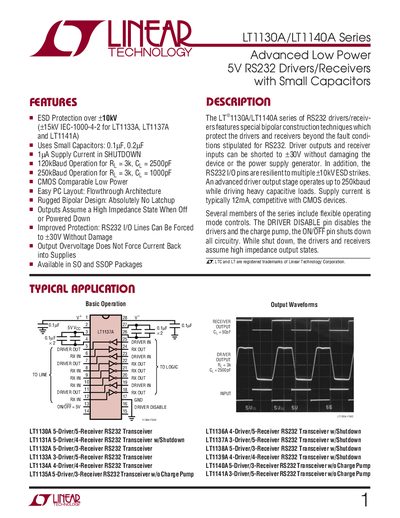
The LT1130A/LT1140A series consists of advanced 5V RS232 drivers and receivers featuring special bipolar construction techniques. These devices offer robust protection, allowing driver outputs and receiver inputs to be shorted to +30V without damaging the device or power supply generator. They also provide ESD protection over +10kV (IEC-1000-4-2) for most models.
The series is designed for low-power operation with a typical supply current of 12mA, comparable to CMOS devices. It includes flexible operating mode controls such as DRIVER DISABLE and ON/OFF pins to shut down circuitry or drivers individually. The transceivers are available in various configurations regarding the number of drivers and receivers (e.g., 5-driver/5-receiver) and can operate with external capacitors for charge pumping.
| Supply Current (5V, typical) | 12mA |
|---|---|
| ESD Protection Level | +10kV |
| Output Overvoltage Tolerance | +30V |
The supply current is typically 12mA, which is competitive with CMOS devices.
Yes, improved protection allows RS232 I/O lines to be forced to +30V without damaging the device.
The devices are available in SO and SSOP packages, as well as PDIP.