
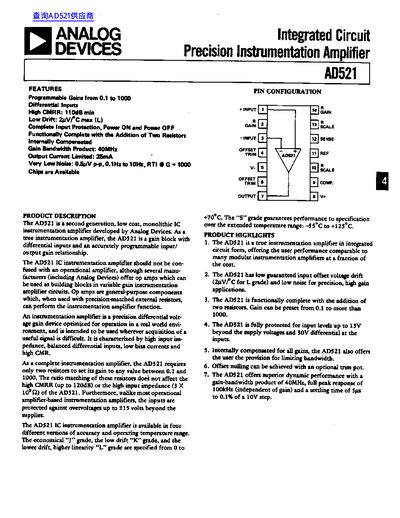
The document describes the AD521 as a second-generation, low-cost monolithic integrated circuit instrumentation amplifier. It is designed to provide differential inputs with an accurately programmable gain ranging from 0.1 to 1000 using only two external resistors.
Key features highlighted include high common-mode rejection ratio (CMRR) of at least 110dB, low input offset voltage drift for precision applications, and complete input protection against overvoltages up to 15V beyond the supplies. The device is available in various grades (J, K, L, S) covering different accuracy levels and operating temperature ranges.
| Gain Range | 0.1 to 1000 |
|---|---|
| CMRR (Min) | 110dB |
| Input Offset Voltage Drift (L Grade) | 2uV/°C max |
| Gain Bandwidth Product | 40MHz |
| Output Current Limit | 26mA |
| Voltage Noise (RTI @ G=1000) | 0.5uV p-p, 0.1Hz to 10Hz |
| Operating Voltage Range | +5V to +28V |
The gain can be preset from 0.1 to more than 1000.
The AD521 requires only two resistors to set its gain.
The inputs are protected against overvoltages up to 15V beyond the supplies.