
The AD7011 is a complete low power CMOS π/4 DQPSK modulator with single +5 V power supply. The part is designed to perform the baseband conversion of I and Q transmit wave- forms in accordance with the American Digital Cellular Tele- phone system (TIA IS-54).
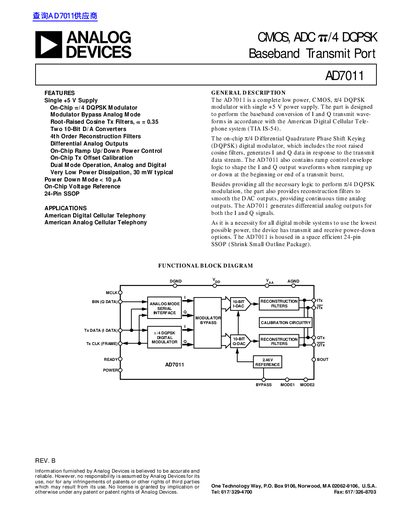
The AD7011 is a complete low power, CMOS, 2/4 Differential Quadrature Phase Shift Keying (DQPSK) modulator designed to perform baseband conversion of I and Q transmit waveforms in accordance with the TIA IS-54 standard. It features an on-chip DQPSK digital modulator that includes root-raised cosine filters, generating I and Q data in response to a transmit data stream.
In addition to modulation logic, the device provides reconstruction filters to smooth DAC outputs for continuous time analog generation. The AD7011 generates differential analog outputs for both I and Q signals and operates on a single +5 V supply with very low power dissipation (30 mW typical). It supports dual mode operation between Analog and Digital modes.
| Supply Voltage | +5 V |
|---|---|
| Power Dissipation | 30 mW typical |
| Package Type | 24-pin SSOP |
| DAC Resolution | 10-Bit |
The device is designed to perform baseband conversion in accordance with the American Digital Cellular Telephone system (TIA IS-54).
Yes, it is an electrostatic discharge sensitive device requiring proper precautions to avoid performance degradation.