
The TK5552 is a complete programmable R/W transponder that implements all important functions for identification systems. It allows the contactless reading and writing of data which are transmitted bi-directionally between a read/write base station and the transponder.
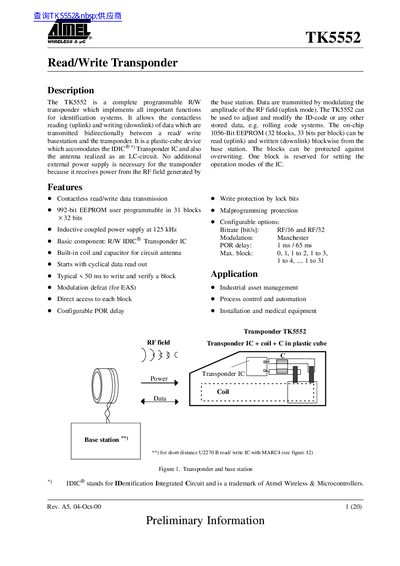
The document describes the Atmel TK5552, a complete programmable read/write (R/W) transponder designed for identification systems. It functions as a plastic-cube device containing an IDIC Transponder IC, a built-in coil, and a capacitor to form an LC circuit antenna.
The device operates at a nominal frequency of 125 kHz using inductive coupled power supply derived from the RF field generated by a base station. Key features include contactless bidirectional data transmission, a 992-bit user-programmable EEPROM organized into 32 blocks, and protection mechanisms such as lock bits and malprogramming protection.
| Operating temperature range | -25 to +75 °C |
|---|---|
| Storage temperature range | -40 to +125 °C |
| EEPROM capacity | 992-bit (32 blocks, 33 bits per block) |
| Data retention | 10 Years |
| Programming cycles | 100,000 |
The typical time to write and verify a block is less than 50 ms.
No, it receives power from the RF field generated by the base station.
The default programmed modulation is Manchester Modulation.