
The MAX4516/MAX4517 are single-pole/single-throw (SPST), CMOS, low-voltage, dual-supply analog switches with very low switch on-resistance. The MAX4516 is normally open (NO). The MAX4517 is normally closed (NC). These CMOS switches can operate continuously with dual supplies between ±1V and ±6V. Each switch can handle rail-to-rail analog signals. The off-leakage current maximum is only 1nA at +25°C or 20nA at +85°C. The digital input is referenced to the positive power supply and is CMOS compatible. For pin-compatible parts for use with a single supply, refer to the MAX4514/MAX415.
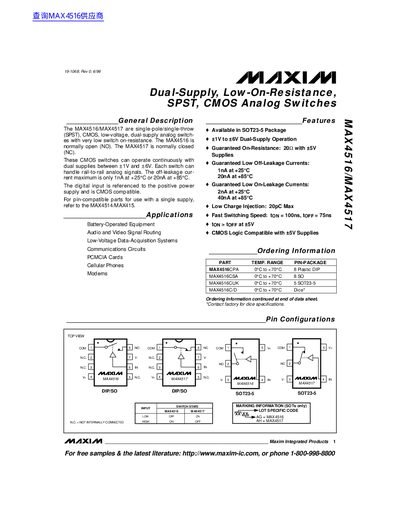
The document describes the MAX4516 (normally open) and MAX4517 (normally closed), which are single-pole/single-throw (SPST), CMOS, low-voltage, dual-supply analog switches with very low switch on-resistance. These devices can operate continuously with dual supplies between +1V and +6V and handle rail-to-rail analog signals.
| On-Resistance (Typical) | 2 ohms at +5V Supply |
|---|---|
| Off-Leakage Current (Max) | 1nA at +25°C |
| Charge Injection (Max) | 20pC |
| Turn-On Time (Typical) | 100ns at +5V |
| Power-Supply Range | +1V to +6V Dual-Supply |
The MAX4516 is normally open (NO), while the MAX4517 is normally closed (NC).
No, the logic-level thresholds are CMOS-compatible but not TTL-compatible.