
The MAX4789 series switches feature internal current limiting to prevent damage to host devices due to faulty load conditions. These analog switches have a low 0.2Ω on-resistance and operate from 2.3V to 5.5V input voltage range. They are avail- able with guaranteed 200mA, 250mA, and 300mA cur- rent limits, making them ideal for SDIO and other load switching applications. When the switch is on and a load is connected to the port, a guaranteed blanking time of 14ms ensures that the transient voltages settle down. If after this blanking time the load current is greater than the current limit, the MAX4789, MAX4791, and MAX4793 enter a latch- off state where the switch is turned off and FLAG is issued to the microprocessor. The switch can be turned on again by cycling the power or the ON pin. The MAX4790, MAX4792, and MAX4794 have an autoretry feature where the switch turns off after the blanking time and then continuously checks to see if the overload condition is present. The switch remains on after the overload condition disappears.
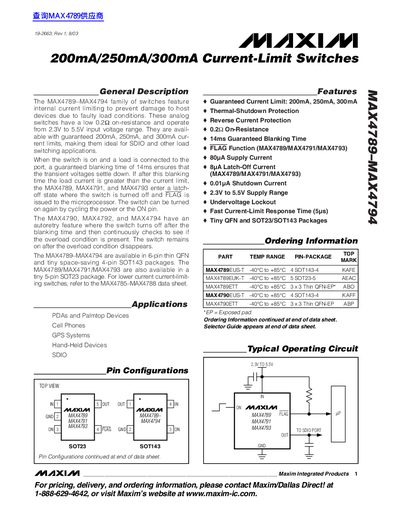
The MAX4789-MAX4794 family consists of analog switches featuring internal current limiting to protect host devices from faulty load conditions. These devices operate from a supply voltage range of 2.3V to 5.5V and are available with guaranteed current limits of 200mA, 250mA, or 300mA.
The family includes models with different fault handling behaviors: some feature an autoretry function that continuously checks for overload conditions after a blanking time, while others enter a latch-off state requiring power cycling to reset. Key features include a low on-resistance of 0.2Ω, thermal-shutdown protection at 150°C, and reverse current protection.
| Operating Voltage Range | 2.3V to 5.5V |
|---|---|
| Guaranteed Current Limit Options | 200mA, 250mA, 300mA |
| On-Resistance (Typical) | 0.2Ω |
| Blanking Time | 14ms |
| Thermal-Shutdown Temperature | 150°C |
| Undervoltage Lockout Threshold | 1.8V to 2.2V |
The devices operate from a supply voltage range of 2.3V to 5.5V.
These models have an autoretry feature where the switch turns off after a blanking time and then continuously checks if the overload condition is still present.
The switch enters a latch-off state and must be turned on again by cycling the power or the ON pin.