
T10A series Sibod™ is a new bidirectional TVS diode from Littlefuse. It has high energy absorption capacity, low junction capacitance, high reliability, and is suitable for use in telephone line cards, power supplies and telecommunications equipment.
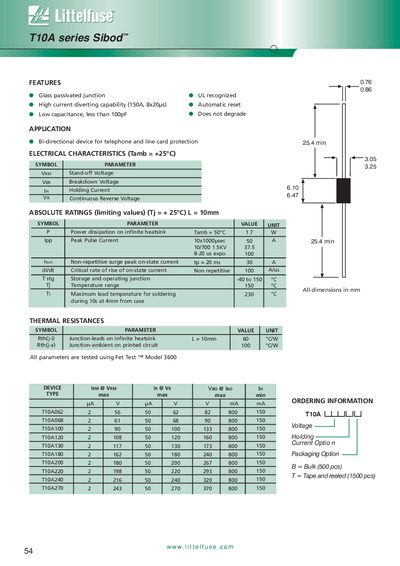
The T10A series is a glass‑passivated, UL‑recognized, high‑current diverting device designed for bi‑directional telephone and line‑card protection. It offers low capacitance (<100 pF), automatic reset, and does not degrade over time.
The document lists key specifications such as a 1.7 W power dissipation on an infinite heatsink, 50 A peak pulse current (10 µs × 1000 µs), 6.47 V continuous reverse voltage, and a holding current of 6.10 A. Ordering codes for various voltage ratings and packaging options are also provided.
| Power dissipation (infinite heatsink, Tamb=50°C) | 1.7 W |
|---|---|
| Peak Pulse Current (10×1000 µs) | 50 A |
| Continuous Reverse Voltage (VR) | 6.47 V |
| Holding Current (IW) | 6.10 A |
| Junction‑ambient thermal resistance (Rth(j‑a)) | 100 °C/W |
The device can handle a peak pulse current of 50 A for a 10 µs × 1000 µs pulse.
It is rated for 1.7 W of power dissipation when mounted on an infinite heatsink at 50 °C ambient temperature.
It is used as a bi‑directional protection device for telephone and line‑card circuits.