
SB30-03T is a Schottky barrier diode produced by SANYO. It has a rated voltage of 30V and a maximum current of 3A. It features low voltage drop, fast recovery time and low noise.
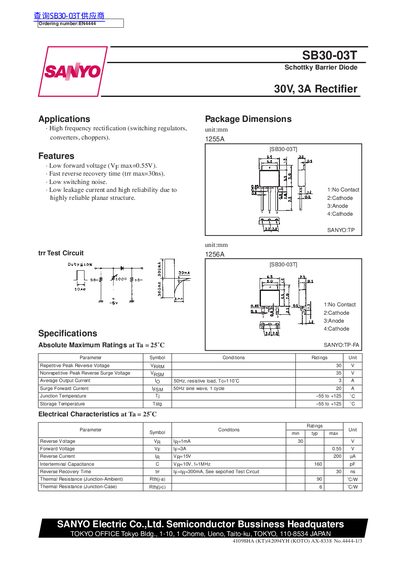
The SB30-03T is a Schottky barrier diode designed for high‑frequency rectification in switching regulators, converters and choppers. Its planar structure provides low forward voltage, low leakage, and high reliability.
Key specifications include a 30 V repetitive reverse voltage, 0.55 V typical forward drop at 3 A, 30 ns reverse‑recovery time, and a maximum junction temperature of +125 °C. Electrical characteristics such as capacitance (160 pF) and thermal resistance (90 °C/W junction‑ambient) are also listed.
| Repetitive Peak Reverse Voltage (VRRM) | 30 V |
|---|---|
| Non‑repetitive Peak Reverse Surge Voltage (VRSM) | 35 V |
| Average Output Current (Io) | 3 A |
| Surge Forward Current (IFSM) | 20 A |
| Junction Temperature Range (Tj) | -55 °C to +125 °C |
| Typical Forward Voltage (VF) at 3 A | 0.55 V |
| Reverse Current (IR) at VR=15 V | 200 pA |
| Interterminal Capacitance (Cc) at 10 V, 1 MHz | 160 pF |
| Thermal Resistance Junction‑Ambient (RθJA) | 90 °C/W |
| Thermal Resistance Junction‑Case (RθJC) | 6 °C/W |
The device can withstand a repetitive reverse voltage of 30 V.
The typical forward voltage drop is 0.55 V when conducting 3 A.
It is rated for junction temperatures from –55 °C up to +125 °C.