
The R1122N Series are voltage regulator ICs with high output voltage accuracy, extremely low supply current, low ON- resistance and high ripple rejection by CMOS process. Each of these voltage regulator ICs consists of a voltage reference unit, an error amplifier, resistors, a current limit circuit, and a chip enable circuit. These ICs perform with low dropout voltage and a chip enable function. The line transient response and load transient response of the R1122N Series are excellent, thus these ICs are very suitable for the power supply for hand-held communication equipment. The output voltage of these ICs is fixed with high accuracy. Since the package for these ICs are SOT-23-5 (Mini-mold) package, high density mounting of the ICs on boards is possible.
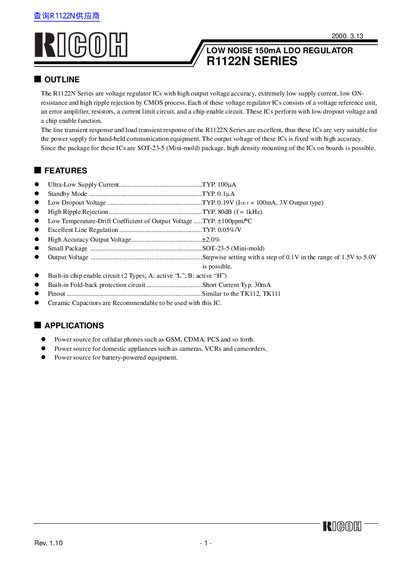
The R1122N series are low‑dropout (LDO) voltage regulator ICs featuring ultra‑low supply current, high ripple rejection, and precise output voltage. They are offered in a compact SOT‑23‑5 (Mini‑mold) package and support stepwise output voltage adjustment from 1.5 V to 5.0 V in 0.1 V increments.
Typical applications include power sources for cellular phones, cameras, VCRs, camcorders, and other battery‑powered equipment. The datasheet provides detailed electrical characteristics, pin configuration, maximum ratings, and recommended layout and capacitor guidelines for stable operation.
| Ultra‑Low Supply Current | 100 µA typ. |
|---|---|
| Standby Mode Current | 0.1 µA typ. |
| Low Dropout Voltage | 0.19 V typ. (Iout=100 mA, Vout=3 V) |
| Ripple Rejection | 80 dB typ. at 1 kHz |
| Temperature‑Drift Coefficient | +100 ppm/°C typ. |
| Output Voltage Accuracy | ±2.0 % |
| Package | SOT‑23‑5 (Mini‑mold) |
| Input Voltage Rating | 2.0 V to 6.0 V |
| Maximum Output Current | 200 mA |
| Power Dissipation | 250 mW max |
| Operating Temperature | -40 °C to 85 °C |
| Storage Temperature | -55 °C to 125 °C |
The typical supply current is 100 µA.
The dropout voltage is 0.19 V typ. when the load current is 100 mA and Vout is 3 V.
It is supplied in a SOT‑23‑5 (Mini‑mold) package.
Typical applications include power sources for cellular phones, cameras, VCRs, camcorders, and other battery‑powered equipment.