
The S1T8825B is a high-performance dual frequency synthesizer with two integrated high-frequency pre-scalers for RF operation up to 1.3 GHz. It is composed of modulus pre-scalers providing 64 and 66, no dead-zone PFD, selectable charge pump current, selectable power down mode circuits, lock detector output, and loop filter’s time constant switch. It is fabricated using the ASP5HB Bi-CMOS process and is available in a 16-TSSOP package. Serial data is transferred into the S1T8825B via a three-wire interface (CK, DATA, EN).
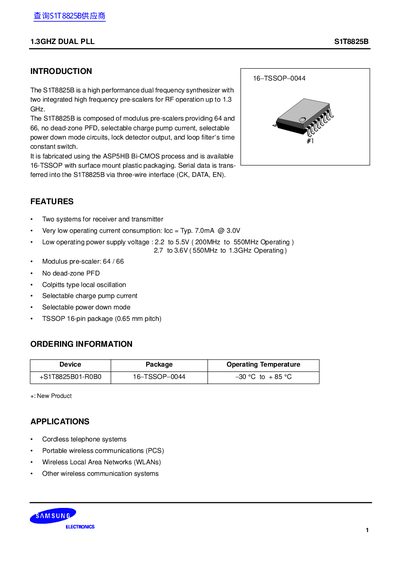
The S1T8825B is a dual frequency synthesizer that operates up to 1.3 GHz. It integrates two modulus pre‑scalers (64/66), a dead‑zone‑free phase‑frequency detector, selectable charge‑pump current, and a power‑down mode. The device is fabricated in a Bi‑CMOS process and supplied in a 16‑TSSOP‑44 surface‑mount package.
Typical applications include cordless telephone systems, portable wireless communications, WLANs and other wireless communication systems. The part is controlled via a three‑wire serial interface (CK, DATA, EN) that allows programming of reference dividers, charge‑pump settings and lock‑detector output.
| Typical operating current consumption | 7.0 mA @ 3.0 V |
|---|---|
| Power dissipation | 600 mW |
| Modulus pre‑scaler | 64 / 66 |
| Dead‑zone PFD | No dead‑zone |
Typical current consumption is 7.0 mA at a 3.0 V supply.