
QST2 is a power transistor produced by ROHM. Its application scenarios include low frequency amplifiers and drivers. Its features are large collector current, low collector saturation voltage, and collector-emitter saturation voltage of -250mV when collector current is -3A and emitter current is -60mA.
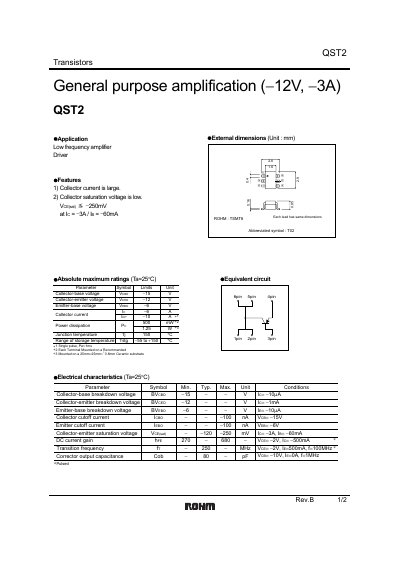
The QST2 is a general‑purpose amplification transistor with a large collector current capability and low collector‑saturation voltage. The document lists absolute maximum ratings, electrical characteristics, and recommended packaging dimensions.
Key specifications include collector current limits, breakdown voltages, gain range, and saturation voltages under various test conditions. Application notes and an appendix outline typical usage and export control information.
| Maximum collector current (IC) | -3 A |
|---|---|
| Collector‑emitter saturation voltage (VCE(sat)) at IC = -3 A | -250 mV |
| DC current gain (hFE) range | 270 – 680 |
| Collector‑base breakdown voltage (BVCBO) | -15 V |
| Collector‑base voltage (VCBO) | -15 V |
The QST2 can handle a collector current of up to -3 A.
At a collector current of -3 A, VCE(sat) is -250 mV.
The transistor’s hFE ranges from 270 to 680.
BVCBO is specified as -15 V.