
This document is the user manual of Amphenol C 091 B series connectors. It mainly introduces the characteristics of the connectors, including the types of connectors, installation methods, temperature range, etc.
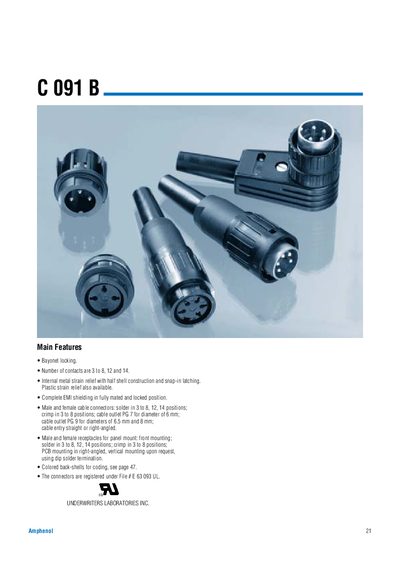
The C091B series from Amphenol provides bayonet‑locking cable connectors with options for male and female, straight or right‑angled mounting, and a range of contact counts (3‑14). Both solder and crimp termination methods are supported, and the connectors offer full EMI shielding when mated.
The datasheet lists electrical ratings such as 300 V rated voltage and 1500 V impulse withstand, mechanical data including IP40 protection and up to 1000 mating cycles for gold‑plated contacts, and material choices like die‑cast nickel‑plated housings with silver or gold contact plating.
| Rated voltage | 300 V |
|---|---|
| Rated impulse withstand voltage | 1500 V |
| Current rating | 5 A @ +40 °C |
| Insulation resistance | >10⁹ Ω |
| Contact resistance | <5 mΩ |
| IP protection | IP40 |
| Insertion force | 25 N – 60 N (depending on configuration) |
| Mating cycles (silver contacts) | 500 cycles |
| Locking system | Bayonet |
It uses a bayonet locking system.
Contacts can be plated with either silver or gold.
The connector is rated for 300 V.