
This document describes the features and characteristics of Amphenol 23 connectors, including temperature range, protected ground requirements for metal housing parts, contact arrangement, and electrical characteristics.
The Amphenol C091 B is a male cable connector with a bayonet locking mechanism. It is offered with various cable outlet sizes (6 mm, 8 mm, 6.5 mm) and can be terminated by solder or crimp. Contact plating options include silver or gold, and the housing is die‑cast with a nickel‑plated finish.
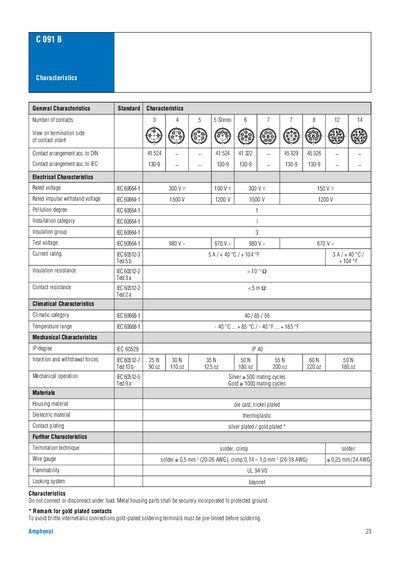
Key specifications include a rated voltage of 300 V, impulse withstand voltage up to 1500 V, current rating of 5 A at +40 °C, IP‑40 protection, and climatic category 40/85/56. Silver‑plated contacts are rated for 500 mating cycles, while gold‑plated contacts support 1000 cycles. The connector complies with IEC standards for insulation, resistance, and mechanical performance.
| Number of contacts | 3, 4, 5, 5 Stereo, 6 |
|---|---|
| Installation category | IEC 606641 |
| Mating cycles (silver contacts) | 500 |
| Mating cycles (gold contacts) | 1000 |
| Housing material | Die cast, nickel plated |
| Contact plating | Silver plated / gold plated |
| Termination technique | Solder or crimp |
| Flammability rating | UL 94 V0 |
| Locking system | Bayonet |
It can be terminated by solder or by crimp.
Gold‑plated contacts are rated for 1000 mating cycles.