
The NCP300 and NCP301 series are second generation ultra-low current voltage detectors. These devices are specifically designed for use as reset controllers in portable microprocessor based systems where extended battery life is paramount. Each series features a highly accurate undervoltage detector with hysteresis which prevents erratic system reset operation as the comparator threshold is crossed. The NCP300 series consists of complementary output devices that are available with either an active high or active low reset output. The NCP301 series has an open drain N-Channel output with either an active high or active low reset output. The NCP300 and NCP301 device series are available in the Thin TSOP-5 package with standard undervoltage thresholds. Additional thresholds that range from 0.9 V to 4.9 V in 100 mV steps can be manufactured.
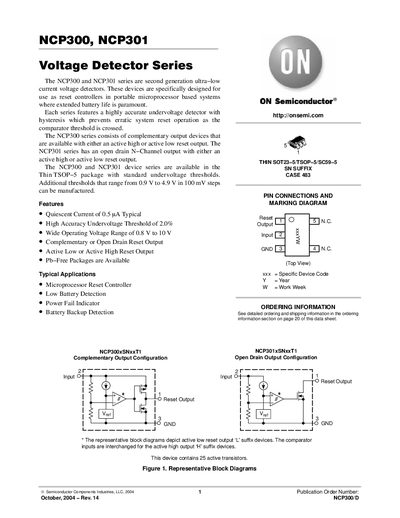
The NCP300 and NCP301 voltage detector series from ON Semiconductor provide highly accurate undervoltage detection with hysteresis, making them suitable for reset control in portable micro‑processor systems where battery life is critical. Both series are offered in thin SOT‑23‑5/TSOP‑5/SC59‑5 packages with selectable active‑high, active‑low, or open‑drain reset outputs.
Key electrical characteristics include a quiescent current of 0.5 µA typical, an operating voltage range of 0.8 V to 10 V, and a maximum output current of 70 mA. The devices feature a 2.0 % accuracy on the undervoltage threshold and are available with multiple threshold options from 0.9 V to 4.9 V in 100 mV steps.
| Quiescent Current | 0.5 µA typical |
|---|---|
| Undervoltage Threshold Accuracy | 2.0 % |
| Operating Voltage Range (Input) | 0.8 V to 10 V |
| Maximum Output Current (Pin 1) | 70 mA |
| Maximum Input Voltage (Pin 2) | 12 V |
| Thermal Resistance (J‑A) | 250 °C/W |
| Typical Detector Threshold (NCP300/1) | 0.9 V |
| Supply Current at Vin=0.8 V | 0.20 µA |
The quiescent current is 0.5 µA typical.
They operate from 0.8 V up to 10 V on the input pin.
The device can source up to 70 mA on the reset output pin.
The undervoltage threshold is accurate to within 2.0 %.