
The MAX3223 is an RS-232 bus-pin ESD protection device that exceeds ±15 kV ESD protection using the Human-Body Model (HBM). It meets or exceeds the requirements of TIA/EIA-232-F and ITU v.28 standards. The device operates with a 3V to 5.5V VCC supply and supports data signaling rates up to 250 kbit/s. It features two drivers and two receivers, low standby current, and is suitable for applications such as battery-powered systems, PDAs, notebooks, laptops, palmtop PCs, and hand-held equipment.
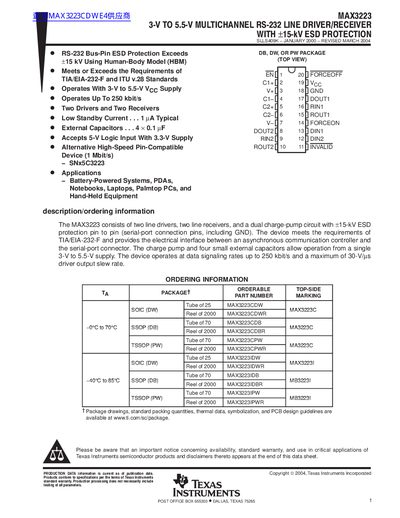
The MAX3223 integrates two line drivers, two line receivers, and a dual charge‑pump circuit that enables operation from a single 3‑V to 5.5‑V supply. It meets TIA/EIA‑232‑F and ITU‑V.28 standards and provides pin‑to‑pin +15‑kV ESD protection for all serial‑port pins, including GND. The device can operate at data signaling rates up to 250 kbit/s and features a maximum driver output slew rate of 30 V/µs.
An auto‑powerdown feature reduces standby current to about 1 µA when the serial port is inactive. The feature can be enabled or disabled via the FORCEON and FORCEOFF pins, and the INVALID output indicates whether a valid RS‑232 signal is present. Detailed electrical characteristics, absolute‑maximum ratings, and recommended operating conditions are provided for each package type (DW, PW, etc.).
| Supply voltage range (VCC) | 3 V to 5.5 V |
|---|---|
| Maximum data rate | 250 kbit/s |
| ESD protection | +15 kV (Human‑Body Model) |
The MAX3223 operates from a single supply voltage between 3 V and 5.5 V.
It can handle data rates up to 250 kbit/s.
The device offers +15 kV ESD protection on all serial‑port pins using the Human‑Body Model.