
The SP7651 is a high voltage synchronous step-down switching regulator optimized for high efficiency from Sipex Corporation
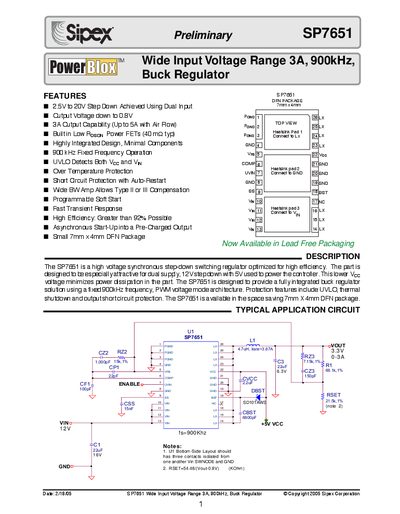
The SP7651 is a high‑voltage synchronous step‑down switching regulator optimized for high efficiency, offering a wide input range (2.5 V‑20 V) and up to 3 A output current (5 A with airflow). It operates at a fixed 900 kHz frequency in a compact 7 mm × 4 mm DFN package.
This handbook details the device’s features, absolute maximum ratings, electrical specifications, pin functions, theory of operation, and application design guidance such as inductor and capacitor selection, soft‑start configuration, and protection mechanisms.
| Output voltage range | down to 0.8 V |
|---|---|
| Input voltage range | 2.5 V – 20 V |
| Maximum output current | 3 A (up to 5 A with airflow) |
| Switching frequency | 900 kHz (fixed) |
| Efficiency | > 92 % |
| Package size | 7 mm × 4 mm DFN |
| UVLO start threshold | 4.00 V – 4.25 V |
| Thermal shutdown temperature | 145 °C |
| Soft‑start current | 10 µA |
The device can deliver up to 3 A continuously, and up to 5 A when adequate airflow is provided.
The regulator operates at a fixed 900 kHz switching frequency.
Connect an external capacitor between the SS pin and GND; the soft‑start rate is set by the 10 µA pull‑up current and the internal 0.8 V reference.