
The SP5730 is a single chip frequency synthesizer designed for tuning systems up to 1.3GHz and is optimized for digital terrestrial applications. The RF preamplifier interfaces directly with the RF programmable divider, which is of MN1A construction so giving a step size equal to the loop comparison frequency and no RF prescaler phase noise degradation over the full RF operating range. The comparison frequency can be obtained either from an on-chip crystal controlled oscillator, or from an external source. The oscillator frequency, fREF, or phase comparator frequency, fCOMP, can be switched to the REF/COMP output providing a reference for a second frequency synthesizer. The synthesizer is controlled via an I2C bus and is fast mode compliant with 3.3V and 5V logic levels.
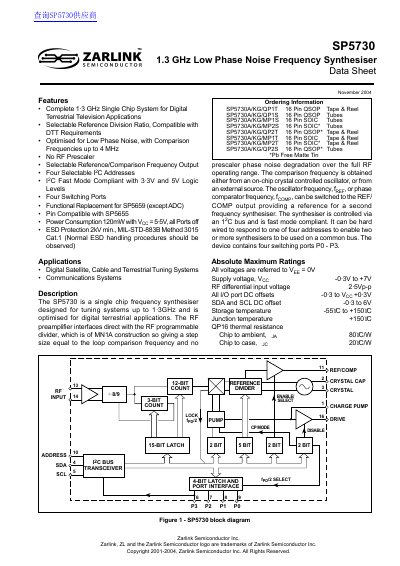
The SP5730 frequency synthesizer is designed for digital terrestrial television and other tuning systems up to 1.3 GHz. It features a selectable reference division ratio, low phase noise, and supports comparison frequencies up to 4 MHz. The device is controlled via an I²C bus, compatible with both 3.3 V and 5 V logic levels, and offers four selectable I²C addresses.
The datasheet provides electrical characteristics, absolute maximum ratings, pin configurations, and programming details. It includes ordering information for various package types (QSOP, SOIC) and outlines test modes, write/read procedures, and application notes for integrating the synthesizer into tuning systems.
| Frequency range | 100 MHz – 1.3 GHz |
|---|---|
| Maximum comparison frequency | 4 MHz |
| Power consumption | 120 mW (VCC = 5.5 V, all ports off) |
| ESD protection | 2 kV minimum (MIL‑STD‑883B Method 3015 Cat.1) |
| I²C addresses | Four selectable addresses |
| Supply voltage (VCC) | 4.5 V – 5.5 V |
| Operating temperature | -40 °C – +85 °C |
| Package options | 16‑pin QSOP or SOIC (tape & reel or tubes) |
The device consumes 120 mW when VCC is 5.5 V and all ports are off.
It can be set to any of four selectable I²C addresses.
The synthesizer supports comparison frequencies up to 4 MHz.
The device is rated for ambient temperatures from –40 °C to +85 °C.