
The LM2937 is a positive voltage regulator capable of supplying up to 500 mA of load current. The use of a PNP power transistor provides a low dropout voltage characteristic. With a load current of 500 mA the minimum input to output voltage differential required for the output to remain in regulation is typically 0.5V (1V guaranteed maximum over the full operating temperature range).
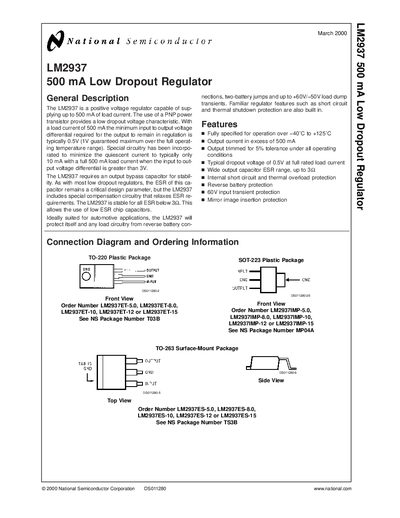
The LM2937 is a positive‑voltage, low‑dropout regulator capable of delivering up to 500 mA of load current. It uses a PNP power transistor to achieve a typical dropout voltage of 0.5 V at full load and includes internal short‑circuit and thermal‑shutdown protection.
The document includes ordering information for TO‑220, TO‑263, and SOT‑223 packages, detailed electrical characteristics, typical performance graphs, and application hints such as output capacitor requirements and heatsinking guidelines.
| Typical Dropout Voltage | 0.5 V at full load |
|---|---|
| Maximum Input Voltage | 60 V |
| Quiescent Current (typical) | 10 mA |
| Output Capacitor ESR Limit | ≤ 3 Ω |
| Operating Temperature Range | -40 °C to +125 °C |
Typical dropout voltage is 0.5 V when delivering the full 500 mA load.