
08051C103JA72A is a ceramic capacitor with a capacitance range of 100pF to 2200pF and a rated voltage of 10V to 200V. It can be used in various electronic devices, including mobile phones, tablets and laptops.
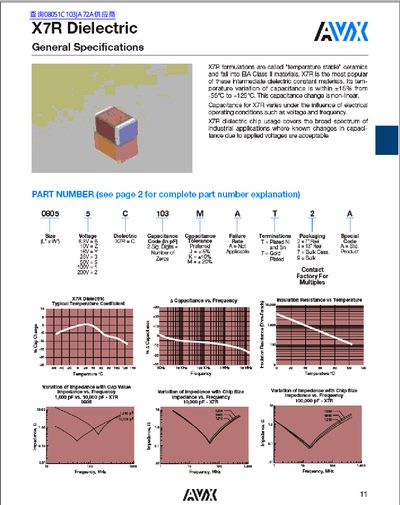
The X7R dielectric is a temperature‑stable ceramic material used in a wide range of industrial capacitor applications. It offers a capacitance variation of ±15% from –65 °C to +125 °C and typical tolerances of ±5 % to ±20 %.
The document lists detailed electrical specifications, high‑voltage chip options, packaging formats, and handling guidelines for surface‑mount assembly, including recommended soldering temperatures and stress‑relief practices.
| Operating Temperature Range | -65 °C to +125 °C |
|---|---|
| Capacitance Tolerances | +5 %, +10 %, +20 % |
| Dissipation Factor | 0.1 % max at 25 °C, 1 kHz |
| Voltage Ratings | 500 V to 5000 V DC |
| Insulation Resistance (25 °C, 500 V) | ≥100 kΩ·MΩ or 1000 MΩ·UF, whichever is less |
| Dielectric Strength | 500 V, 150 % rated voltage for 5 s at 50 mA |
X7R dielectric capacitors operate from –65 °C up to +125 °C.
Available voltage ratings are 500 V, 600 V, 1 kV, 1.5 kV, 2 kV, 2.5 kV, 3 kV, 4 kV and 5 kV DC.
The solder temperature should not exceed 230 °C.