
This document describes the features and characteristics of the 16-bit CAN-enabled CompactRISC microcontroller family, including high performance, integrated features, and low power consumption.
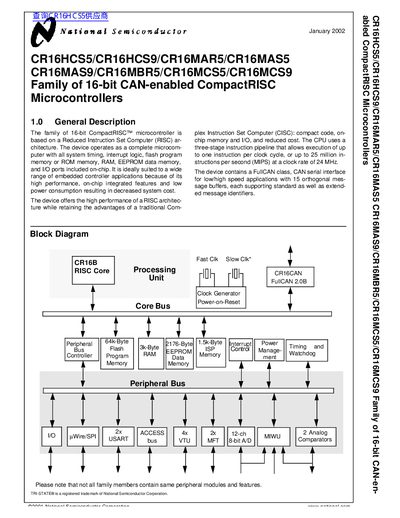
This handbook provides a comprehensive description of the CR16 family of 16‑bit CAN‑enabled CompactRISC microcontrollers. It covers the CPU core, memory organization, I/O ports, bus interface, interrupt system, power‑management modes, and on‑chip peripherals such as timers, USARTs, A/D converter, CAN interface, and ACCESS.bus.
The document also details register layouts, programming procedures, and electrical characteristics, helping developers design and debug embedded applications that use the CR16HCS5, CR16HCS9, CR16MAR5, and CR16MAS5 devices.
| Flash program memory | up to 64 KB |
|---|---|
| Flash EEPROM (ISP) memory | 1.5 KB |
| Static RAM | 3 KB |
| Non‑volatile EEPROM data memory (low endurance) | 2 KB |
| High‑endurance EEPROM data memory | 128 bytes |
| General‑purpose I/O pins | up to 56 |
| USART modules | 2 |
| A/D converter channels | 12‑channel 8‑bit |
| CAN message buffers | 15 |
| Maximum clock speed | 24 MHz |
| Supply voltage | 4.5 V to 5.5 V |
| Operating temperature range | -40 °C to +85 °C |
The device provides up to 64 KB of reprogrammable flash EEPROM program memory.
The microcontroller offers up to 56 software‑controllable I/O pins.
It can operate at a clock rate of up to 24 MHz.
The device works from a single‑supply voltage of 4.5 V to 5.5 V.