
Maxim's redesigned DG411/DG412/DG413 analog switches now feature low on-resistance matching between switches (3Ω max) and guaranteed on-resistance flatness over the signal range (Δ4Ω max). These low on-resistance switches conduct equally well in either direction. They guarantee low charge injection, low power consumption, and an ESD tolerance of 2000V minimum per Method 3015.7. The new design offers lower off-leakage current over temperature (less than 5nA at +85°C). The DG411/DG412/DG413 are quad, single-pole/single-throw (SPST) analog switches. The DG411 is normally closed (NC), and the DG412 is normally open (NO). The DG413 has two NC switches and two NO switches. Switching times are less than 150ns max for tON and less than 100ns max for tOFF. These devices operate from a single +10V to +30V supply, or bipolar ±4.5V to ±20V supplies. Maxim's improved DG411/DG412/DG413 are fabricated with a 44V silicon-gate process.
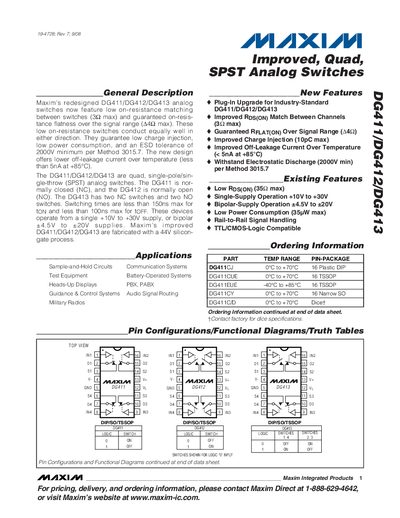
The Maxim DG411/DG412/DG413 family are quad, single‑pole/single‑throw analog switches with low on‑resistance, low charge injection, and high ESD tolerance. The DG411 is normally‑closed, the DG412 normally‑open, and the DG413 combines two of each. They operate from a single +10 V to +30 V supply or a bipolar +4.5 V to +20 V supply and are fabricated with a 44 V silicon‑gate process.
The datasheet provides absolute maximum ratings, electrical characteristics for both dual‑ and single‑supply operation, typical performance graphs, pin descriptions, timing diagrams, and package information for DIP, TSSOP, SO, QFN and other formats.
| On‑Resistance (RDS(on)) max | 3 Ω max |
|---|---|
| On‑Resistance flatness (RFLAT(ON)) max | 4 Ω max |
| Switching time (ton) max | 150 ns max |
| Power consumption max | 35 µW max |
| Off‑leakage current max | 5 nA at +85 °C |
| ESD tolerance | 2000 V minimum |
| Supply voltage range | single +10 V to +30 V or bipolar +4.5 V to +20 V |
| Operating temperature range (typical) | 0 °C to +70 °C (some variants to +125 °C) |
The on‑resistance is limited to 3 Ω max per channel.
They can be powered from a single +10 V to +30 V supply or from bipolar +4.5 V to +20 V supplies.
They are rated for at least 2000 V ESD tolerance per Method 3015.7.