
The MAX5407 is a 32-point audio logarithmic taper digital potentiometer with a resistance from 10kΩ to 1MΩ, 1dB resolution, and single supply of 2.7V-5.5V and 0.35uA static current
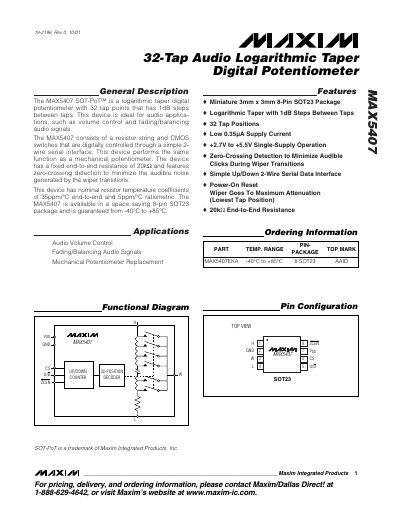
The MAX5407 SOT‑PoT™ is a logarithmic‑taper digital potentiometer designed for audio applications such as volume control and signal fading. It provides 32 tap positions with 1 dB steps, a fixed 20 kΩ end‑to‑end resistance, and operates from a single‑supply voltage of 2.7 V to 5.5 V.
Control is achieved via a simple 2‑wire serial interface (CS and U/D pins) with optional zero‑crossing detection to minimize audible clicks during wiper transitions. The device is supplied in an 8‑pin SOT‑23 package and is rated for –40 °C to +85 °C operation.
| Number of Taps | 32 |
|---|---|
| Tap Step | 1 dB |
| End‑to‑End Resistance | 20 kΩ |
| Supply Voltage Range | 2.7 V to 5.5 V |
| Operating Temperature Range | -40 °C to +85 °C |
| Zero‑Crossing Detection | Enabled |
The device provides 32 tap positions.
It uses a simple 2‑wire serial interface with CS and U/D pins.
The device operates from 2.7 V to 5.5 V.
Yes, zero‑crossing detection is provided to reduce audible clicks during wiper transitions.