
The MAX5408-MAX5411 are dual, logarithmic taper digital potentiometers from Texas Instruments, each with 32 tap points, which replace mechanical potentiometers in audio applications requiring digitally controlled resistors. The MAX5408/MAX5410 are dual potentiometers with one wiper per potentiometer, while the MAX5409/MAX5411 are dual potentiometers with two wipers per potentiometer. An SPI-compatible serial interface controls the wiper positions. The MAX5408-MAX5411 have a factory-set resistance of 10k ohms per potentiometer. A zero-crossing detect feature minimizes the audible noise generated by wiper transitions. The MAX5408-MAX5411 have nominal temperature coefficients of 35 ppm/°C end-to-end and 5 ppm/°C ratiometric. The MAX5408-MAX5411 are available in 16-pin QSOP and 16-pin thin QFN packages and are specified over the extended temperature range (-40°C to +85°C). Applications include stereo volume control, fading and balancing stereo signals, and mechanical potentiometer replacement.
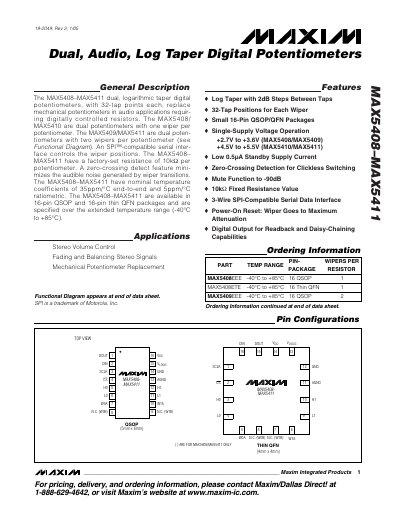
The MAX5408–MAX5411 family are dual, logarithmic‑taper digital potentiometers designed for audio applications. Each potentiometer provides 32 tap positions, a factory‑set 10 kΩ resistance, and features such as zero‑crossing detection and mute function to minimize audible noise.
The devices operate from a single‑supply voltage (+2.7 V to +3.6 V for MAX5408/MAX5409, +4.5 V to +5.5 V for MAX5410/MAX5411) and are available in 16‑pin QSOP and thin QFN packages. An SPI‑compatible serial interface controls wiper positions, supports daisy‑chaining, and provides digital read‑back.
| Number of taps per wiper | 32 |
|---|---|
| Factory‑set resistance per potentiometer | 10 kΩ |
| Standby supply current | 0.2 µA |
| End‑to‑end temperature coefficient | 35 ppm/°C |
| Ratiometric temperature coefficient | 5 ppm/°C |
| Operating temperature range | -40 °C to +85 °C |
| Package options | 16‑pin QSOP, 16‑pin thin QFN |
Each wiper provides 32 tap positions.
Zero‑crossing detection minimizes audible noise when the wiper moves.
When mute is enabled, the attenuation is set to –90 dB.