
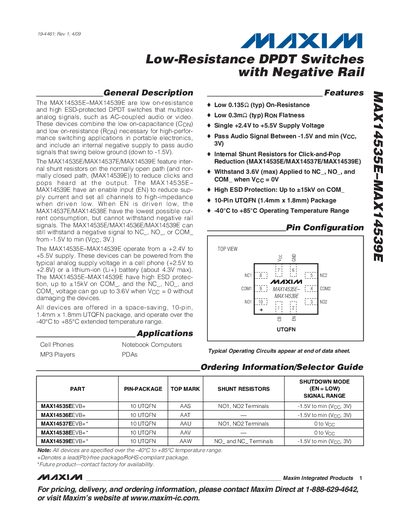
The MAX14535E‑MAX14539E family are low‑on‑resistance, high‑ESD‑protected DPDT switches designed to multiplex AC‑coupled analog signals such as audio or video. They operate from a +2.4 V to +5.5 V supply and include an internal negative‑rail charge pump that allows signal swing down to –1.5 V.
These devices feature internal shunt resistors for click‑and‑pop reduction, an enable input (EN) for shutdown mode, and robust ESD protection up to +15 kV on the COM pins. Typical applications include cell phones, notebook computers, MP3 players, and PDAs.
| Typical On‑Resistance (Ron) | 0.135 Ω |
|---|---|
| Ron Flatness (Rflat) | 0.3 Ω |
| Supply Voltage Range | +2.4 V to +5.5 V |
| ESD Protection (COM pins) | Up to +15 kV (HBM) |
| Operating Temperature Range | -40 °C to +85 °C |
| Continuous Current (NO/NC/COM terminals) | 4.3 A |
| Enable Input (EN) Function | High for normal operation, low for shutdown/high‑impedance |
It operates from a single supply of +2.4 V to +5.5 V.
The typical on‑resistance is 0.135 Ω.
The COM pins are protected against up to +15 kV (Human Body Model).
EN enables normal operation when high and places the device in a shutdown, high‑impedance state when low.