
The MAX7057 frequency-programmable UHF transmitter is designed to transmit ASK/FSK data at a wide range of frequencies from 300MHz to 450MHz. The MAX7057 has internal tuning capacitors at the output of the power amplifier that are programmable for matching to an antenna or load. This allows the user to change to a new frequency and match the antenna at the new frequency simultaneously. The MAX7057 transmits at a data rate up to 100kbps nonreturn-to-zero (NRZ) (50kbps Manchester coded). Typical transmitted power into a 50Ω load is +9.2dBm with a +2.7V supply. The device operates from +2.1V to +3.6V and typically draws under 12.5mA of current in FSK mode (8.5mA in ASK mode) when the antenna-matching network is designed to operate over the 315MHz to 433.92MHz frequency range. For narrower operating frequency ranges, the matching network can be redesigned to improve efficiency. The standby current is less than 1µA at room temperature. The MAX7057 reference frequency from the crystal oscillator is multiplied by a fully integrated fractional-N phase-locked loop (PLL). The multiplying factor of the PLL is set by a 16-bit number, with 4 bits for integer and 12 bits for fraction; the multiplying factor can be anywhere between 19 and 28. The 12-bit fraction in the synthesizer sets a tuning resolution equal to the reference frequency divided by 4096; frequency deviation can be set as low as ±2kHz and as high as ±100kHz. The fractional-N synthesizer eliminates the PLL lock-up time, which is dependent on the reference frequency and the required division ratio. The MAX7057 supports adaptive crystal compensation, which compensates for temperature and voltage-induced frequency drift.
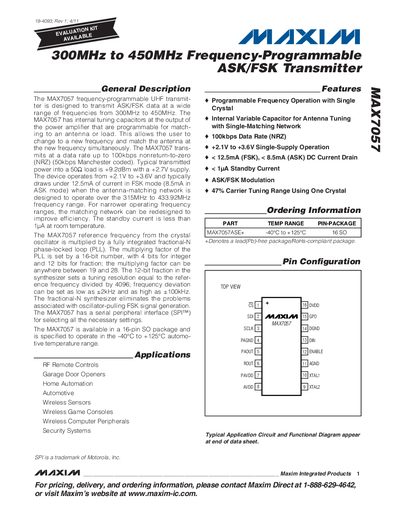
The MAX7057 is a frequency‑programmable UHF transmitter covering 300 MHz to 450 MHz. It supports ASK and FSK modulation, delivers up to 100 kbps NRZ (or 50 kbps Manchester) data rates, and includes internal tuning capacitors for antenna matching.
The device operates from a single 2.1 V to 3.6 V supply, draws less than 12.5 mA in FSK mode (8.5 mA in ASK), and has a standby current below 1 pA. It is controlled via an SPI interface and is supplied in a 16‑pin SO package suitable for automotive temperature ranges.
| Frequency Range | 300 MHz – 450 MHz |
|---|---|
| Supply Voltage | 2.1 V – 3.6 V |
| Standby Current | < 1 pA |
| Maximum Data Rate | 100 kbps NRZ (50 kbps Manchester) |
| Supply Current (FSK) | < 12.5 mA |
| Supply Current (ASK) | < 8.5 mA |
It operates from 2.1 V to 3.6 V.
The standby current is less than 1 pA at room temperature.
It can transmit up to 100 kbps using NRZ encoding or 50 kbps using Manchester coding.
The device can be programmed from 300 MHz to 450 MHz.