
This document is the datasheet for AD8260, introducing the features and characteristics of AD8260.
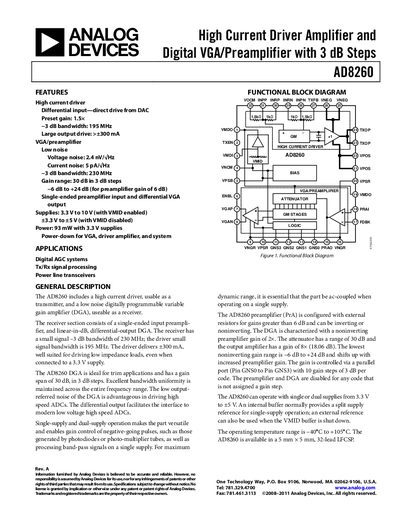
The AD8260 combines a high‑current driver suitable for transmitter use with a low‑noise, digitally programmable variable‑gain amplifier (VGA) for receiver applications. It supports single‑supply operation from 3.3 V to 10 V and dual‑supply operation up to +5 V, delivering more than 300 mA to low‑impedance loads.
The device offers a gain range of –6 dB to +24 dB in 3 dB steps, a small‑signal bandwidth of 195 MHz (driver) and 230 MHz (VGA), and includes an internal VMID buffer for single‑supply operation. It is packaged in a 5 mm × 5 mm, 32‑lead LFCSP and qualified for –40 °C to +105 °C operation.
| Supply Voltage | 3.3 V to 10 V (single‑supply) / +3.3 V to +5 V (dual‑supply) |
|---|---|
| Operating Temperature Range | -40 °C to +105 °C |
| Driver Small‑Signal Bandwidth | 195 MHz |
| VGA Small‑Signal Bandwidth | 230 MHz |
| Maximum Output Current | > 300 mA |
| Power Dissipation (no signal) | 93 mW |
| Gain Step per Code | 3 dB |
It is rated for operation from –40 °C up to +105 °C.
The driver can source more than 300 mA to low‑impedance loads.