
ADA4940-1/ADA4940-2 are low noise, low distortion fully differential ADC drivers with extremely low power consumption and distortion.
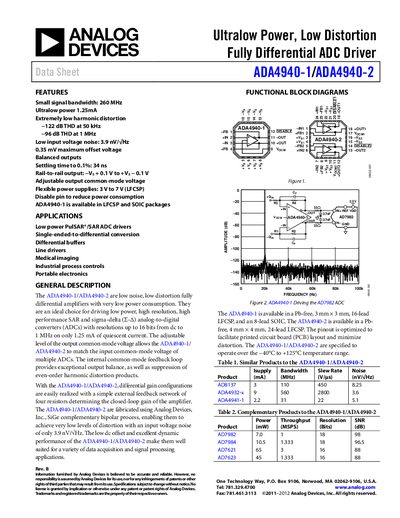
The ADA4940-1 and ADA4940-2 are ultralow‑power, low‑distortion fully differential ADC drivers designed for high‑resolution SAR and sigma‑delta converters. They provide rail‑to‑rail output, adjustable common‑mode voltage, and a disable pin for power saving.
Key specifications include a 260 MHz small‑signal bandwidth (5 V supply), typical 1.25 mA quiescent current per enabled amplifier, 3.9 nV/√Hz input voltage noise at 100 kHz, and operation over –40 °C to +125 °C. The devices are offered in 8‑lead SOIC and 16‑/24‑lead LFCSP packages and support supply voltages from 3 V to 7 V.
| Quiescent Current per Amplifier (Enabled) | 1.25 mA (typical) |
|---|---|
| Input Voltage Noise (100 kHz) | 3.9 nV/√Hz |
| Output Swing (Rail‑to‑Rail) | –Vs + 0.1 V to +Vs – 0.1 V |
| Operating Temperature Range | –40 °C to +125 °C |
| Supply Voltage Range | 3 V to 7 V |
| Settling Time to 0.1 % | 34 ns |
Each enabled amplifier draws about 1.25 mA typical.
The input voltage noise is 3.9 nV/√Hz at 100 kHz.
They operate from –40 °C to +125 °C.