
This document describes the electrical specifications and features of the NTQ160 series product, including input range, frequency, efficiency, EMI filtering, power factor, output power, overload protection, overvoltage protection, etc.
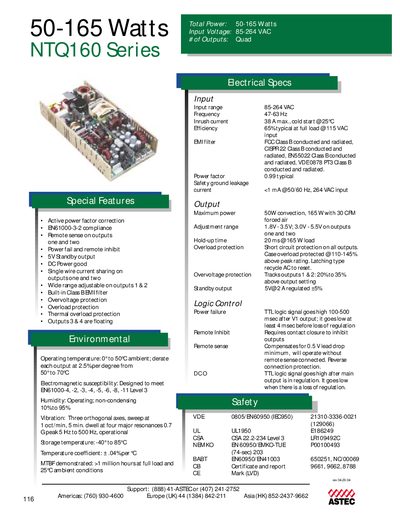
The NTQ160 Series is a quad‑output AC‑DC power supply delivering 50‑165 W with active power‑factor correction, remote sense, and built‑in Class B EMI filtering. It offers adjustable output ranges, overload and over‑voltage protection, and a standby 5 V output.
Environmental ratings include operation from 0 °C to 50 °C (derating to 70 °C), humidity 10‑95 % non‑condensing, and vibration resistance. The series complies with EN61000‑3‑2, EN61000‑4, and carries CE, UL, CSA, and other safety certifications. Ordering information and connector pin‑outs are provided for global distributors.
| Total Power | 50‑165 W |
|---|---|
| Input Voltage | 85‑264 VAC |
| Number of Outputs | Quad |
| Operating Temperature | 0 °C to 50 °C ambient |
| MTBF | >1 million hours at full load and 25 °C |
| Short‑Circuit Protection | Enabled on all outputs |
The NTQ160 Series accepts an input voltage of 85 VAC to 264 VAC.
It provides four independent output channels (quad).
The demonstrated MTBF is greater than 1 million hours at full load and 25 °C ambient temperature.