
74ALVC14 is a high-performance, low-power, low-voltage, Si-gate CMOS device, superior to most advanced CMOS compatible TTL families
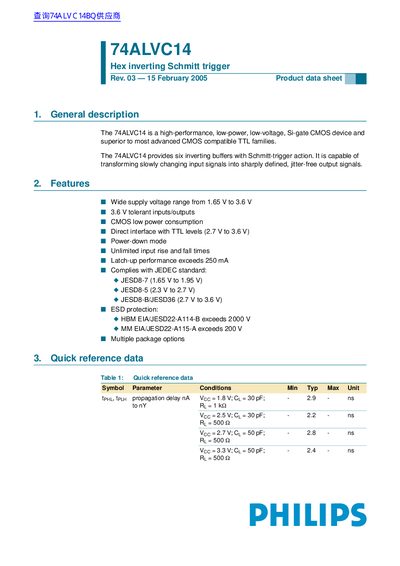
The 74ALVC14 is a high‑performance, low‑power, low‑voltage CMOS hex inverting Schmitt‑trigger device that converts slowly changing inputs into sharply defined outputs. It offers six inverting buffers with Schmitt‑trigger action and operates over a wide supply voltage range.
The data sheet includes sections on features, quick reference data, ordering information, functional diagrams, pinning details, electrical limits, recommended operating conditions, static and dynamic characteristics, waveforms, and transfer characteristics, as well as application notes and contact information.
| Supply voltage range | 1.65 V to 3.6 V |
|---|---|
| Number of inverting buffers | 6 |
| Input capacitance per buffer | 3.5 pF |
| Typical propagation delay (tPHL) | 1.0 ns |
| Operating temperature range | -40 °C to +85 °C |
It provides six inverting buffers.
The device operates from 1.65 V up to 3.6 V.
Each buffer has an input capacitance of about 3.5 pF.
The recommended ambient temperature range is –40 °C to +85 °C.