
The GD65232 and GD75232 are single chips that provide an easy interface between the UART and serial-port connector of IBM PC/AT and compatibles. They meet or exceed the requirements of TIA/EIA-232-F and ITU v.28 standards and support data rates up to 120 kbit/s.
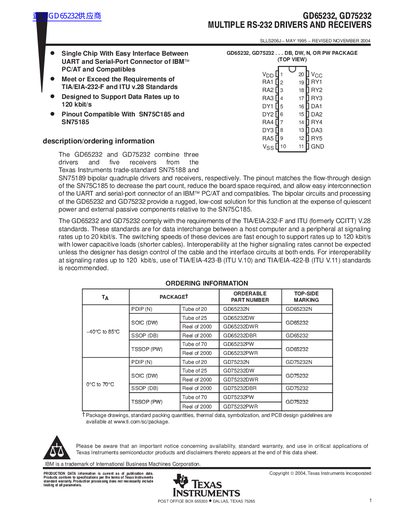
The GD65232 and GD75232 combine three drivers and five receivers from Texas Instruments' SN75188 and SN75189 families. Their pinout matches the flow‑through design of the SN75C185, reducing part count and board space while providing easy interconnection with IBM PC/AT serial‑port connectors.
These devices comply with TIA/EIA‑232‑F and ITU V.28 standards and support data rates up to 120 kbit/s. Recommended supply voltages are Vpp 7.5‑15 V, Vss –7.5‑‑15 V, and Voc 4.5‑5.5 V. Operating temperature ranges are –40 °C to 85 °C for GD65232 and –40 °C to 70 °C for GD75232. Various packages (PDIP, DW, DB, PW) are offered with standard ordering codes.
| Supply voltage (Vpp) | 9 V |
|---|---|
| Supply voltage (Vss) | -9 V |
| Operating temperature (GD65232) | -40 °C to 85 °C |
| Operating temperature (GD75232) | -40 °C to 70 °C |
| Package type (example) | PDIP (N) |
Vpb (positive supply) is recommended between 7.5 V and 15 V, Vss (negative supply) between –7.5 V and –15 V, and Voc (output supply) between 4.5 V and 5.5 V.