
The DS90C387/DS90CF388 is a transmitter/receiver pair that supports dual pixel data transmission between the host and flat panel display up to QXGA resolutions. It offers multiple modes and features, including dual pixel data transmission, single pixel data transmission, and interoperability with FPD-Link devices.
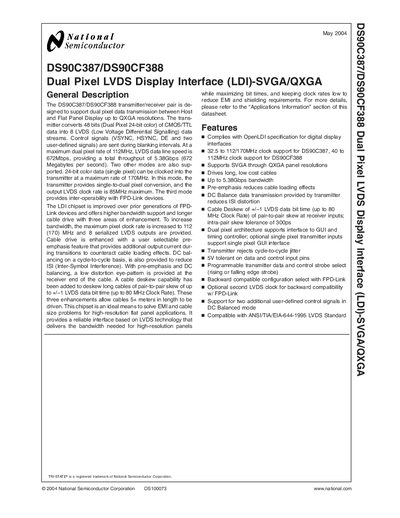
The DS90C387/DS90CF388 transmitter/receiver pair provides dual‑pixel LVDS data transmission for high‑resolution flat‑panel displays. It converts 48‑bit dual‑pixel data into eight LVDS streams and supports up to QXGA panel resolutions.
Key features include pre‑emphasis and DC‑balancing for reduced cable loading, cable deskew up to +/-1 LVDS data‑bit time, and compliance with the OpenLDI and ANSI/TIA/EIA‑644 LVDS standards. Electrical specifications such as maximum dual‑pixel rate, supply currents, and voltage ranges are detailed in the document.
| Maximum dual pixel rate | 112 MHz |
|---|---|
| LVDS data line speed | 672 Mbps |
| Total throughput | 5.38 Gbps (672 Megabytes per second) |
| Cable deskew capability | +/-1 LVDS data bit time (up to 80 MHz clock rate) |
| Supply voltage range (DS90C387) | -0.3 V to +4 V |
It supports SVGA through QXGA panel resolutions.
The LVDS data line can operate at up to 672 Mbps.
It provides a cable deskew function of +/-1 LVDS data‑bit time, effective up to an 80 MHz clock rate.