
This document describes a slight potential for PHY lock-up in a receiving node (including a repeating node) when a peer node is powered off or unplugged while transmitting data to the receiving node. If node B is unplugged or powered down while transmitting, its peer node A could see corrupted data on its port's twisted pair lines during the unplug or powerdown sequence. A rare condition has been discovered in which the node A PHY has the potential to enter a lock-up state after receiving a particular sequence of corrupted signals on the twisted pairs during unplug or powerdown of node B as node B is transmitting. Node A does see the bus reset event caused by the unplug or powerdown of node B but does not complete the collection of valid SelfID's. When in this state, the node A PHY is unaware of and does not respond to the bus reset caused by the plug-in of a new node C (or to the power-up of node B), this causes the just-connected node B or C to continuously issue bus resets. This causes the entire network to cease to function until the node A PHY is hard reset or disconnected from the network. This condition has never been reported in normal use; rather, it was observed in rigorous lab testing. All future releases of these devices shall have this issue fixed.
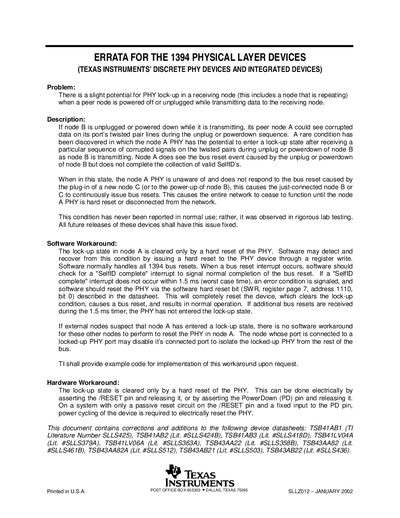
The document reports a potential lock‑up condition that can occur in Texas Instruments' 1394 physical layer devices when a peer node is powered off or unplugged during data transmission. The affected devices may see corrupted signals, fail to complete SelfID, and become unresponsive to subsequent bus resets.
Two workarounds are provided: a software method that issues a hard reset via the SWR register (page 7, address 1110, bit 0) after a missed SelfID interrupt, and a hardware method that asserts the /RESET or PowerDown (PD) pins to force a hard reset. The errata lists the specific device part numbers that are impacted.
| SelfID complete timeout | 1.5 ms |
|---|---|
| Software hard‑reset register | Page 7, address 1110, bit 0 |
| Hardware reset pins | /RESET, PowerDown (PD) |