
This document describes the features and applications of low drop-out linear regulators, as well as the advantages of high-performance linear regulators using ZBD849 and ZBD949 transistors.
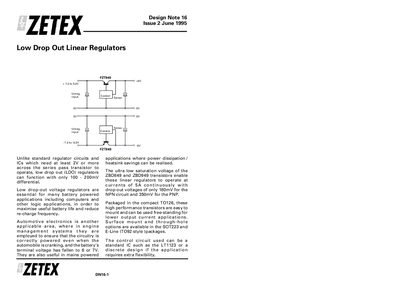
This design note introduces ZETEX low drop-out (LDO) linear regulators, explaining how they can operate with only a 100‑200 mV differential compared to standard regulators that require at least 2 V. The note highlights the benefits of LDO regulators for battery‑powered devices, automotive engine‑management systems, and mains‑powered applications where reduced heat dissipation is valuable.
The document details the ultra‑low saturation voltage of ZBD849 and ZBD949 transistors, enabling continuous 5 A operation with drop‑out voltages as low as 180 mV (NPN) or 350 mV (PNP). Various package options are offered, including TO126, SOT223, and E‑Line (TO‑92 style), and the control circuit can use a standard IC such as the LT1123 or a discrete design for added flexibility.
| Maximum Input Voltage | 45 V |
|---|---|
| Continuous Current | 5 A |
| Drop‑out Voltage (NPN) | 180 mV |
| Drop‑out Voltage (PNP) | 350 mV |
| Package (through‑hole) | TO126 |
| Package (surface‑mount) | SOT223, E‑Line (TO‑92 style) |
They can function with only a 100‑200 mV differential across the pass transistor.
A standard IC such as the LT1123 or a discrete design can be used.