
This document describes the features and characteristics of a digital oscilloscope, including Go-No Go and auto setup sequence, FFT function, built-in help menu, multi-language and PC software. It also provides specifications for the display system, vertical system, and horizontal system of the oscilloscope.
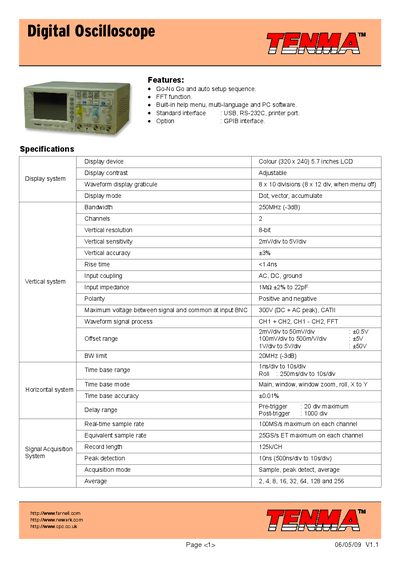
The Tenma 72-7240 is a 2‑channel digital oscilloscope with a 5.7‑inch (320 × 240) colour LCD display. It offers a 250 MHz bandwidth, 8‑bit vertical resolution, and a real‑time sample rate of up to 100 MS/s per channel. Standard interfaces include USB, RS‑232C and a printer port, with an optional GPIB add‑on.
The instrument supports a range of trigger sources, autoset functions, and measurement modes such as FFT, waveform arithmetic, and cursor measurements. Power is supplied from 100‑240 V AC (48‑63 Hz) with auto‑selection, and the package includes a power cord, operation manual, and two GTP‑250A probes.
| Bandwidth | 250 MHz (-3 dB) |
|---|---|
| Channels | 2 |
| Vertical resolution | 8‑bit |
| Input impedance | 1 MΩ 42 % to 22 pF |
| Maximum input voltage | 300 V (DC + AC peak), CATII |
| Sample rate | 100 MS/s per channel |
| Time base range | 1 ns/div to 10 s/div |
| Display size | 5.7 inches LCD (320 × 240) |
| Standard interfaces | USB, RS‑232C, printer port |
| Optional interface | GPIB |
| Power source | 100 V‑240 V AC, 48‑63 Hz, auto selection |
| Accessories included | Power cord, operation manual, two GTP‑250A probes |
It has a bandwidth of 250 MHz (-3 dB).
The instrument offers two input channels.
USB, RS‑232C and a printer port are standard; GPIB is optional.
A power cord, the operation manual, and two GTP‑250A probes are included.