
LTC2483 is a 16-bit high-precision analog-to-digital converter that uses a 2-Wire I2C interface. It has no latency, zero differential input current, etc., and can directly sample and convert high-impedance sensors. It is used in weighing scales, temperature measurement, strain gauge transducers, etc.
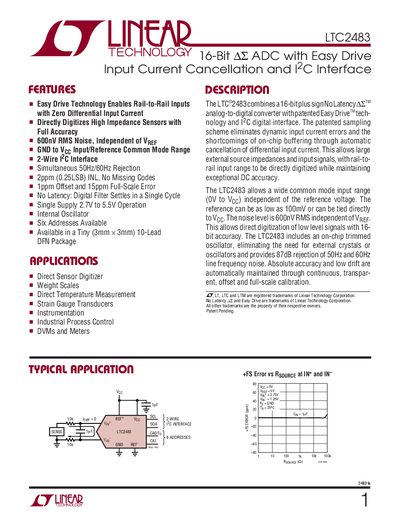
The LTC2483 is a 16‑bit analog‑to‑digital converter featuring Easy Drive technology, rail‑to‑rail inputs, and a 2‑wire I²C interface. It offers high accuracy with no missing codes, low noise, and simultaneous 50 Hz/60 Hz rejection, making it suitable for sensor digitization, temperature measurement, and instrumentation applications.
The document details absolute maximum ratings, electrical characteristics, converter performance, package dimensions, and typical application circuits. It also lists related parts and ordering information for the 10‑lead DFN package.
| RMS Noise | 600 nV RMS |
|---|---|
| Supply Voltage (VCC) | 2.7 V to 5.5 V |
| Package | 10‑Lead (3 mm × 3 mm) Plastic DFN |
| Operating Temperature Range | -40 °C to 85 °C |
| I²C Addresses | Six addresses |
The device operates from 2.7 V to 5.5 V supply voltage.
The LTC2483 provides six selectable I²C addresses.
The converter achieves an RMS noise level of 600 nV.