
This product is a 16-bit programmable DAC with wide battery input range, grounded lamp or floating lamp configurations, open lamp protection, precision 50µA full-scale DAC programming current, standard SPI mode or pulse mode, DAC setting is retained in shutdown.
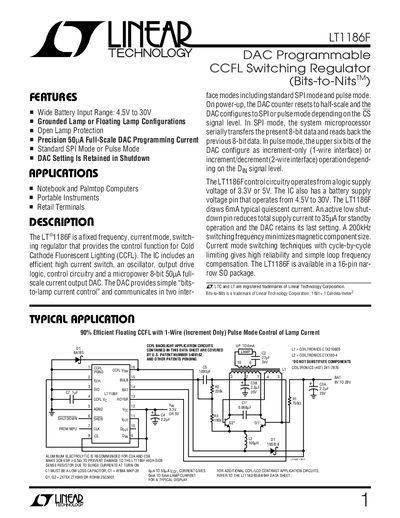
The LT1186F is a fixed‑frequency, current‑mode switching regulator that provides control for Cold Cathode Fluorescent Lighting (CCFL). It integrates a high‑current switch, oscillator, output drive logic, control circuitry and an 8‑bit DAC for simple bits‑to‑lamp current control, supporting both standard SPI and pulse modes.
Key features include a wide battery input range of 4.5 V to 30 V, low typical quiescent current of 6 mA, shutdown current as low as 35 pA, and a 200 kHz switching frequency that minimizes magnetic component size. The device is supplied in a 16‑lead narrow SO package and offers extensive pin functions for analog ground, lamp current programming, and high‑side sense circuitry.
| Input voltage range | 4.5 V to 30 V |
|---|---|
| Typical quiescent current | 6 mA |
| DAC full‑scale current | 50 µA |
The device operates from 4.5 V up to 30 V.
It draws about 6 mA of quiescent current.
The DAC provides a full‑scale current of 50 µA.