
The document introduces the LT3464 micropower boost DC/DC converter, which features a small size, low quiescent current, integrated Schottky diode and output disconnect circuit, and provides short-circuit protection. It supports internal reference voltage override function.
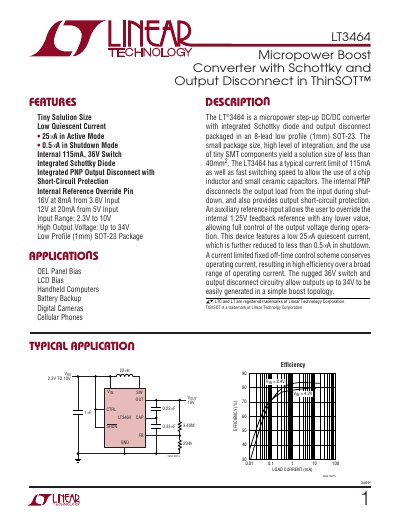
The LT3464 is a micropower step‑up DC/DC converter with an integrated Schottky diode and output‑disconnect, offered in a thin‑SOT‑23 package. It delivers up to 34 V output from input voltages as low as 2.3 V, with a typical quiescent current of 25 µA and a 115 mA current limit.
The document includes detailed electrical characteristics, pin functions, recommended inductor and capacitor selections, and guidance on setting the output voltage using external resistor dividers or the CTRL pin. Application examples and layout recommendations are also provided.
| Input Voltage Range | 2.3 V to 10 V |
|---|---|
| Minimum Input Voltage (typ) | 2.0 V |
| Maximum Output Voltage | 34 V |
It operates from 2.3 V up to 10 V input voltage.
Select resistor values R1 and R2 for the feedback divider, or use the CTRL pin to override the internal reference.
Small surface‑mount inductors such as the Murata LQH32CN220K (22 µH) and similar parts are recommended.