
ADV3226/ADV3227 is a 16×16 high performance switch array, which is pin compatible with AD8114/AD8115, providing a complete solution with buffered inputs and programmable high impedance outputs. It can drive 150Ω loads, operate on ±5V supplies, with low power consumption of 1.3W.
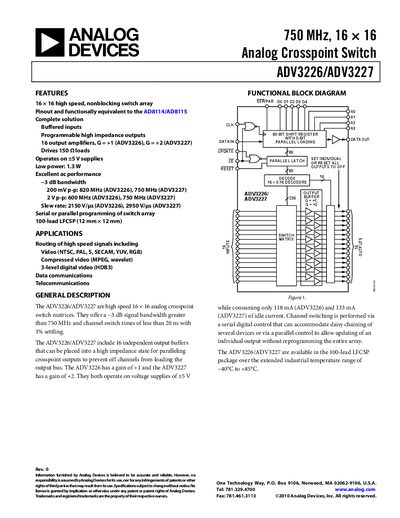
The ADV3226 and ADV3227 are 16 × 16 high‑speed, non‑blocking analog crosspoint switch matrices. They support video formats (NTSC, PAL, YUV, RGB), compressed video, data communications and telecommunications, and feature buffered inputs, programmable high‑impedance outputs, and selectable gain (+1 for ADV3226, +2 for ADV3227). The devices operate from a +5 V supply, draw low power (≈1.3 W) and are available in a 100‑lead LFCSP package.
Key specifications include a –3 dB bandwidth up to 820 MHz (ADV3226) or 750 MHz (ADV3227), switching times of 20 ns, operating temperature range –40 °C to +85 °C, and supply currents of 110 mA (ADV3226) or 130 mA (ADV3227) with outputs enabled. The datasheet also provides pin configurations, timing diagrams for serial and parallel programming, and guidance for building larger crosspoint arrays.
| –3 dB Bandwidth | 820 MHz (ADV3226), 750 MHz (ADV3227) |
|---|
The device operates from a +5 V supply.