
This document describes the features and characteristics of the 750 MHz, 8 × 8 analog crosspoint switch ADV3228/ADV3229. The switch is high speed and nonblocking, with a 16 × 8 array. It has buffered inputs and programmable high impedance outputs. Additionally, the switch has low power consumption and excellent AC performance.
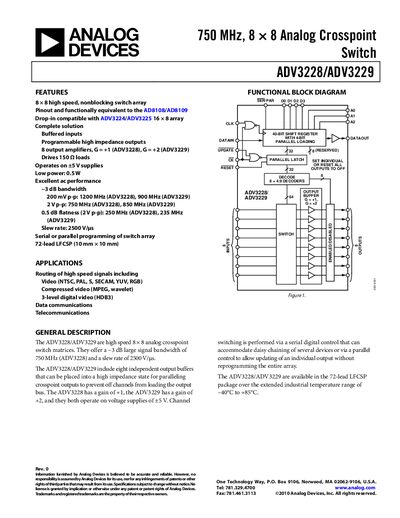
The ADV3228/ADV3229 are high‑speed 8 × 8 analog crosspoint switch matrices designed for routing video, data communications and telecommunications signals. They operate from a +5 V supply, provide low‑power operation (0.5 W) and feature buffered inputs with programmable high‑impedance outputs. The ADV3228 offers unity gain (+1) while the ADV3229 provides a gain of +2, making them suitable for a range of analog switching applications.
Key features include a –3 dB bandwidth of up to 850 MHz, slew rate of 2500 V/µs, serial and parallel programming interfaces, and operation over an industrial temperature range of –40 °C to +85 °C. The devices are supplied in a 72‑lead LFCSP package and include extensive protection against ESD and over‑temperature conditions.
| -3 dB Bandwidth | 750 MHz (ADV3228), 850 MHz (ADV3229) |
|---|---|
| Supply Current AVCC, outputs enabled, no load | 52 mA (ADV3228), 70 mA (ADV3229) |
| Gain | +1 (ADV3228), +2 (ADV3229) |
Both devices operate on a +5 V supply.
The matrix can be programmed either via a serial digital control that supports daisy‑chaining or via a parallel control that updates individual outputs without reprogramming the whole array.