
AD8012* is a dual 350 MHz low power amplifier with features such as low power consumption, high output current, high speed, and low distortion. It is widely used in applications such as XDSL and HDSL line drivers, ADC buffers, professional cameras, CCD imaging systems, ultrasound equipment, and digital cameras.
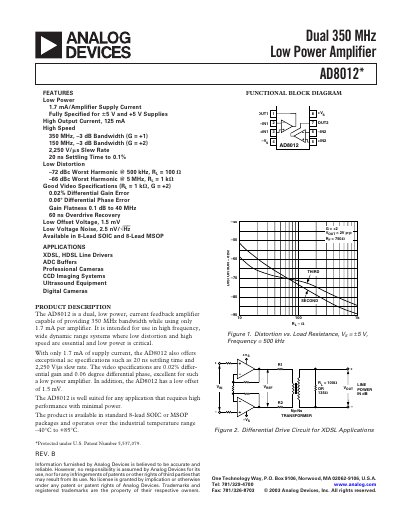
The AD8012 is a dual, low‑power, current‑feedback amplifier that delivers 350 MHz bandwidth while drawing only 1.7 mA per amplifier. It offers high output current (125 mA), fast slew rate (2,250 V/µs), low distortion and low offset voltage, making it suitable for high‑frequency, wide‑dynamic‑range applications.
Typical applications include XDSL/HDSL line drivers, ADC buffers, professional cameras, CCD imaging systems, ultrasound equipment and digital cameras. The device is supplied in 8‑lead SOIC or MSOP packages and operates over an industrial temperature range of –40 °C to +85 °C.
| Supply Current per Amplifier | 1.7 mA |
|---|---|
| Output Current | 125 mA |
| Input Voltage Noise | 2.5 nV/√Hz |
| Input Offset Voltage | ±1.5 mV |
| Dual Supply Voltage Range | ±1.5 V to ±6.0 V |
| Operating Temperature Range | –40 °C to +85 °C |
The AD8012 draws 1.7 mA of supply current per amplifier.
The device can source up to 125 mA of output current.
It is specified for –40 °C to +85 °C operation.