
This document is the Philips LPC3000 Evaluation Board Users Manual, which introduces the evaluation board's features, configuration, power supply, LCD display, serial port configuration, SD card, USB interface, I2C bus, NAND FLASH, ADC configuration, push button switch, etc.
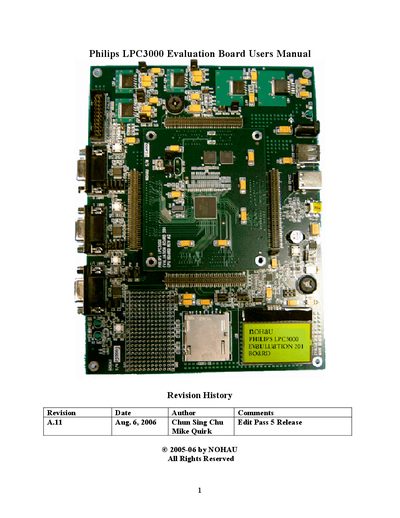
This manual provides detailed instructions for setting up and configuring the Philips LPC3000 evaluation board. It covers power supply requirements, jumper settings, connector usage, and programming of the on‑board NAND flash.
The document also describes the board’s features such as the LCD module, SD‑card slot, USB ports, UART interfaces, break‑out headers, and prototyping area, helping developers quickly evaluate the LPC3000 microcontroller and begin hardware or software development.
| Power supply input | 5.0 V (single input, regulated on board) |
|---|---|
| SDRAM size | 32 M (8 M × 32) bytes |
| NAND flash size | 32 M (32 M × 8) bytes |
| LCD module | Philips PCF8558 built‑in |
| SD‑card connector | 1‑SD Card connector |
| UART interfaces | 3 UART (RS232) ports with DB9 female connectors |
| Break‑out headers | 4‑80 pin headers for microcontroller pins |
| User input switches | 4 push‑button switches |
| User output LEDs | 2 LEDs |
| Prototyping area | 0.1 in spaced through‑hole grid with 3.0 V, 1.8 V power points |
The board uses a single 5.0 V power‑supply input that is regulated on board.
The board provides three UART (RS232) interfaces with standard DB9 female connectors.
The board includes 32 Mbytes of NAND flash (32 M × 8).