
TPIC2810 is a monolithic, medium- voltage, low-current, 8-bit shift register design to drive low-side switched resistive loads such as LEDs. The device contains an 8-bit, serial-in, parallel-out shift register that feeds an 8-bit D-type storage register. Data transfers through the shift register via an I2C bus interface.
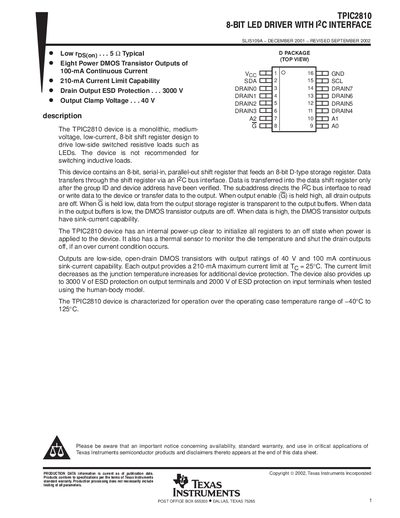
The TPIC2810 is a monolithic 8‑bit shift‑register LED driver designed for low‑side switched resistive loads such as LEDs. It features an I²C serial interface, an internal power‑up clear, and a thermal sensor that shuts the outputs off on over‑current conditions.
Key specifications include 100 mA continuous sink current per output, a 210 mA current‑limit per channel, 3000 V output ESD protection, operation from –40 °C to 125 °C, and a logic supply range of 3.0 V to 5.5 V. The device is not recommended for inductive loads and provides both output and input ESD protection.
| Continuous sink current per output | 100 mA |
|---|---|
| Maximum current limit per output | 210 mA |
| Output ESD protection | 3000 V |
| Input ESD protection | 2000 V |
| Operating temperature range | ‑40 °C to 125 °C |
| Logic supply voltage range | 3.0 V to 5.5 V |
| High‑level input voltage | 0.7 VCC |
| Thermal shutdown set point | 160 °C |
Each output can continuously sink up to 100 mA.
No, the device is not recommended for switching inductive loads.