
The ADS7862 is a 12-bit, 500kHz analog-to-digital converter from TI that features 4 fully differential input channels that can be grouped into two pairs for high-speed simultaneous signal acquisition. It also supports a parallel interface and control inputs to minimize software overhead. The device is available in a TQFP-32 package and operates over a temperature range of -40°C to +85°C.
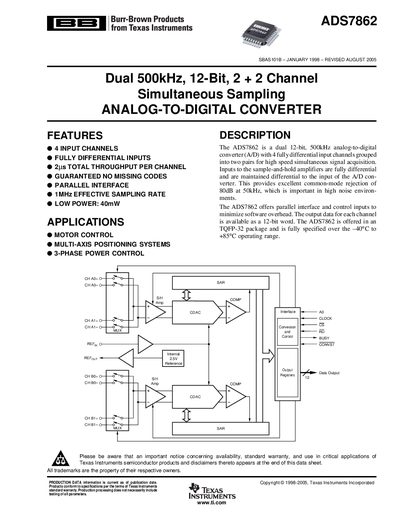
The ADS7862 is a high‑speed, low‑power, dual 12‑bit analog‑to‑digital converter with four fully differential inputs grouped into two simultaneous‑sampling channels. It operates from a single +5 V supply, offers an internal 2.5 V reference, and provides a typical common‑mode rejection of 80 dB.
Key specifications include a 500 kHz maximum throughput per channel, 40 mW power consumption, and operation over a temperature range of 40 °C to +85 °C in a TQFP‑32 package. The datasheet also contains ordering information, mechanical drawings, and the standard TI product warranty notice.
| Resolution | 12 bits |
|---|---|
| Maximum throughput rate | 500 kHz |
| Power consumption | 40 mW |
| Operating temperature range | 40 °C to +85 °C |
| Internal reference voltage | 2.5 V |
| Common‑mode rejection ratio | 80 dB |
| Effective sampling rate | 1 MHz |
The ADS7862 can sample up to 500 kHz per channel.
Typical power consumption is 40 mW.
The internal reference is 2.5 V.