
The INA121 is a low power instrumentation amplifier offering excellent accuracy. Its versatile three-op amp design and very small size make it ideal for a variety of general purpose applications.
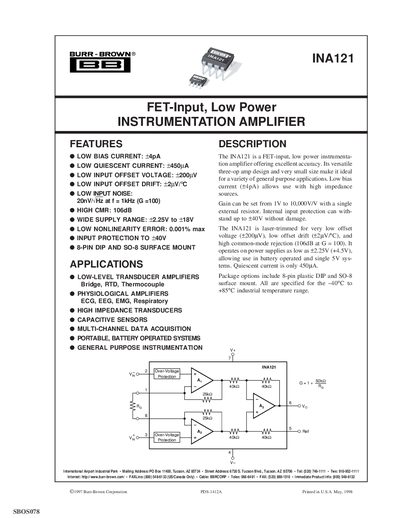
The INA121 is a FET‑input, low‑power instrumentation amplifier with ultra‑low bias current and offset voltage, making it suitable for high‑impedance transducer and physiological signal applications. The datasheet lists its key electrical characteristics, gain options, and recommended external resistor configurations.
The document includes absolute maximum ratings, package options (8‑pin DIP and SO‑8), typical performance curves (gain vs. frequency, noise, step response), and application notes on wiring and gain setting. It also contains ordering information, mechanical dimensions, and TI’s standard legal notices.
| Input Bias Current | +4 pA |
|---|---|
| Input Offset Voltage | 142 µV |
| Gain Range | 1 V/V to 10 000 V/V |
| Quiescent Current | 450 µA |
| CMRR | 106 dB (G = 100) |
| Bandwidth (‑3 dB) | 600 kHz (G = 1) |
The device has an ultra‑low input bias current of about +4 pA.
Gain can be set from 1 V/V up to 10 000 V/V using a single external resistor.
The amplifier draws a low quiescent current of approximately 450 µA.