
This document provides an application note for Sensirion SDP600 series differential pressure sensors, explaining how to compensate for pressure drop in a hose during the measurement process.
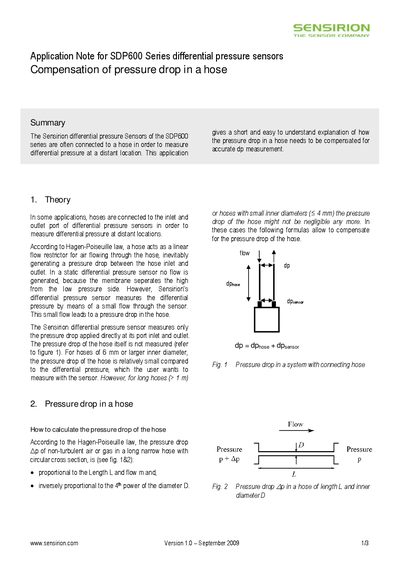
The application note describes the theory behind pressure drop in hoses connected to SDP600 differential pressure sensors. It explains that a hose acts as a linear flow restrictor, causing a pressure drop that is not measured by the sensor itself, and that this drop must be compensated for accurate differential pressure readings.
Formulas based on the Hagen‑Poiseuille law are provided to calculate the pressure drop, along with example calculations and guidelines for hose dimensions. The note also includes characteristic curves of the SDP600 sensor and a revision history.
| Sensor output unit | Pascal (Pa) |
|---|
Calculate the hose pressure drop using the Hagen‑Poiseuille based formulas and add it to the sensor reading (Ap_hose + Apsensor).
Hoses with an inner diameter of 6 mm or larger can be used, as the pressure drop becomes negligible.
Version 1.0 – September 2009.