
Maxim’s MAX8211 and MAX8212 are CMOS micropower voltage detectors that warn microprocessors (µPs) of power failures. Each contains a comparator, a 1.5V bandgap reference, and an open-drain N-channel output driver. Two external resistors are used in conjunction with the internal reference to set the trip voltage to the desired level. A hysteresis output is also included, allowing the user to apply positive feedback for noise-free output switching. The MAX8211 provides a 7mA current-limited output sink whenever the voltage applied to the threshold pin is less than the 1.5V internal reference. In the MAX8212, a voltage greater than 1.5V at the threshold pin turns the output stage on (no current limit). The CMOS MAX8211/MAX8212 are plug-in replacements for the bipolar ICL8211/ICL8212 in applications where the maximum supply voltage is less than 16.5V. They offer several performance advantages, including reduced supply current, a more tightly controlled bandgap reference, and more available current from the hysteresis output.
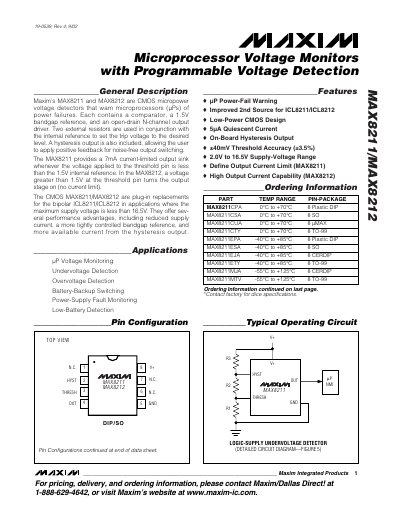
The Maxim MAX8211 and MAX8212 are CMOS micropower voltage detectors that monitor microprocessor supply rails and provide a warning when the voltage falls outside a programmable range. Each device contains a comparator, a 1.5 V band‑gap reference, and an open‑drain output stage, with optional hysteresis for noise‑free switching.
The datasheet details electrical characteristics, pin configurations, package options, and application circuits for undervoltage and overvoltage detection. It also includes design equations for setting the trip voltage and hysteresis using external resistors.
| Supply Voltage Range (typical) | 2.0 V to 16.5 V |
|---|---|
| Supply Voltage Range (absolute) | -0.5 V to +18 V |
| Quiescent Current | 5 µA |
| Maximum Output Current (MAX8211) | 30 mA (current‑limited) |
| Maximum Output Current (MAX8212) | 50 mA (not current‑limited) |
| Threshold Accuracy | ±40 mV (±3.5 %) |
| Storage Temperature Range | -65 °C to +150 °C |
| Lead (soldering) Temperature | +300 °C for 10 s |
Both devices draw only 5 µA of quiescent current, providing a low‑power CMOS design.