
The LM4040 series of shunt voltage references are versatile, easy-to-use references that cater to a vast array of applications. The 2-pin fixed-output device requires no external resistors or capacitors for operation and is stable with all capacitive loads. Additionally, the reference offers low dynamic impedance and low noise, providing stable performance under a wide variety of conditions.
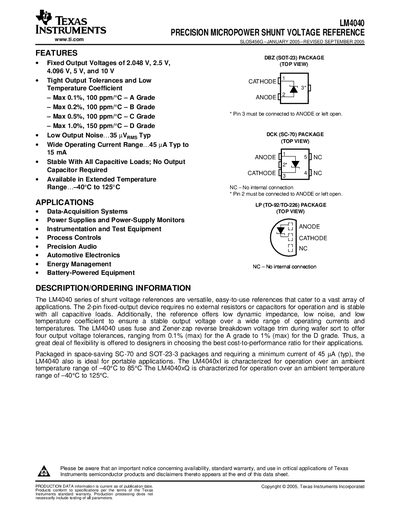
The LM4040 series provides fixed‑output shunt voltage references ranging from 2.048 V to 10 V. It offers tight output tolerances (0.1 %‑1 % depending on grade) and low temperature coefficients, making it suitable for precision instrumentation, power‑supply monitoring, and automotive electronics.
Packaged in compact SC‑70, SOT‑23‑3, and TO‑92 options, the device operates over a wide temperature range (‑40 °C to 125 °C) and requires a minimum cathode current of only 45 pA, enabling use in low‑power and portable applications.
| Operating Temperature Range | -40 °C to 125 °C (depending on grade) |
|---|
The device requires a minimum cathode current of 45 pA typical.
The LM4040 operates from –40 °C up to 125 °C, depending on the grade.