
The LT1073 is a versatile micropower DC/DC converter that only requires three external components to deliver a fixed output of 5V or 12V. With a minimum supply voltage of 1V, it can be used in applications where the primary power source is a single cell. An on-chip auxiliary gain block can function as a low-battery detector or linear post-regulator. The average current drain of the LT1073-5 used in the typical application circuit is just 135µA unloaded, making it ideal for applications where long battery life is important. The circuit shown can deliver 5V at 40mA from an input as low as 1.25V and 5V at 10mA from a 1V input. The device can easily be configured as a step-up or step-down converter, although for most step-down applications or input sources greater than 3V, the LT1173 is recommended. Switch current limiting is user-adjustable by adding a single external resistor. Unique reverse-battery protection circuitry limits reverse current to safe, nondestructive levels at reverse supply voltages up to 1.6V.
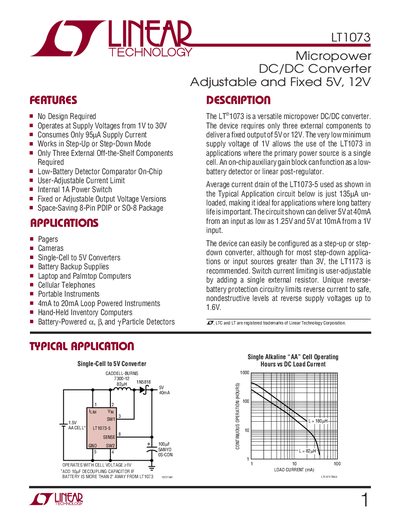
The LT1073 is a versatile micropower DC/DC converter that operates from supply voltages as low as 1 V and up to 30 V. It consumes only 95 pA of supply current in its off state and can be configured for step‑up or step‑down operation with just three external components. Fixed‑output versions (5 V or 12 V) are available in an 8‑pin PDIP or SO‑8 package.
The document includes detailed electrical characteristics, absolute maximum ratings, pin descriptions, and extensive application guidance such as component selection for inductors, capacitors, and diodes, as well as typical circuit examples for single‑cell to 5 V conversion and other low‑power uses.
| Quiescent Current (Switch Off) – Minimum | 95 pA |
|---|---|
| Quiescent Current (Switch Off) – Typical | 130 pA |
| Input Voltage (Step‑Up Mode) – Typical | 12.6 V |
| Output Voltage (LT1073‑5) – Typical | 5 V |
| Maximum Switch Current | 400 mA |
| Oscillator Frequency – Typical | 19 kHz |
| Current Limit – Typical | 400 mA |
The LT1073 draws a minimum of 95 pA and a typical 130 pA of quiescent current when the switch is off.
Only three external off‑the‑shelf components are required.
The typical oscillator frequency is 19 kHz.