
The LMV321, LMV358, and LMV324/LMV324S are single, dual, and quad low-voltage (2.7 V to 5.5 V) operational amplifiers with rail-to-rail output swing. The LMV324S, which is a variation of the standard LMV324, includes a power-saving shutdown feature that reduces supply current to a maximum of 5 µA per channel when the amplifiers are not needed. Channels 1 and 2 together are put in shutdown, as are channels 3 and 4. While in shutdown, the outputs actively are pulled low. The LMV321, LMV358, LMV324, and LMV324S are the most cost-effective solutions for applications where low-voltage operation, space saving, and low cost are needed. These amplifiers were designed specifically for low-voltage (2.7 V to 5 V) operation, with performance specifications meeting or exceeding the LM358 and LM324 devices that operate from 5 V to 30 V. Additional features of the LMV3xx devices
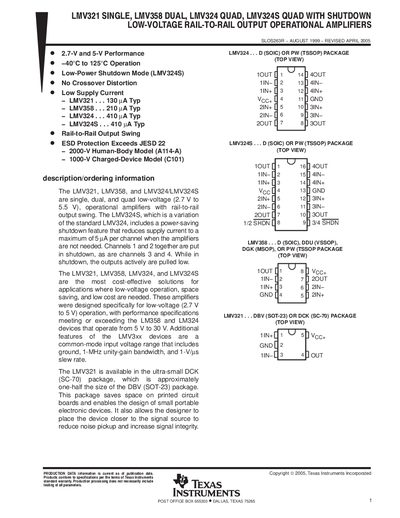
The LMV321 is a single‑channel, low‑voltage (2.7 V to 5.5 V) rail‑to‑rail output operational amplifier designed for space‑constrained, low‑cost applications. It features a shutdown mode that reduces supply current to under 0.6 µA per channel when not in use.
The datasheet provides detailed electrical characteristics, absolute maximum ratings, recommended operating conditions, typical performance curves, mechanical dimensions, and ordering information for the LMV321 and related LMV358/LMV324 families.