
This document describes the features and characteristics of the 213 High Temperature Masking Tape, including its material, adhesive type, physical properties, performance characteristics, and temperature range.
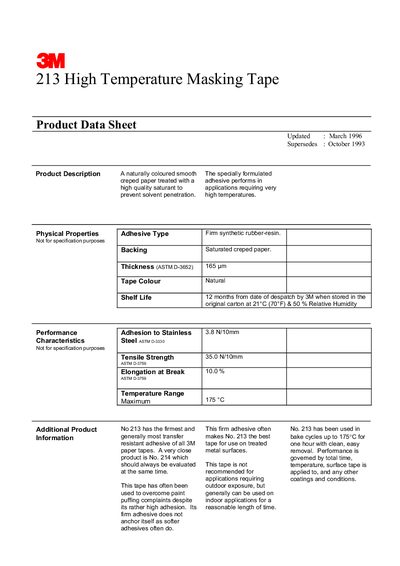
The 3M 213 High Temperature Masking Tape is a naturally coloured, smooth creped paper tape treated with a high‑quality saturant to prevent solvent penetration. It features a firm synthetic rubber‑resin adhesive designed for applications requiring very high temperatures, up to 175 °C.
The sheet provides physical properties, performance characteristics, application techniques, and handling recommendations. It also lists advantages such as high‑temperature holding, adhesive transfer resistance, and easy tear, along with safety and storage guidelines.
| Adhesive Type | Firm synthetic rubber‑resin |
|---|---|
| Backing | Saturated creped paper |
| Thickness (ASTM D‑3652) | 165 µm |
| Tape Colour | Natural |
| Shelf Life | 12 months at 21 °C and 50 % RH |
| Tensile Strength | 35.0 N/10 mm |
| Elongation at Break | 10 % |
| Maximum Temperature | 175 °C |
The tape can be used up to a maximum temperature of 175 °C.
Ideal application temperature is between 21 °C and 38 °C (70 °F to 100 °F).
Shelf life is 12 months from the date of dispatch when stored at 21 °C and 50 % relative humidity.
Surfaces must be clean, dry, and well unified; a typical cleaning solvent is isopropyl alcohol and water.